Mechanosensation, habituation, and behavioural plasticity in tintinnid ciliates

Mechanosensation, habituation, and behavioural plasticity in tintinnid ciliates
Laeverenz-Schlogelhofer, H.; Wan, K. Y.
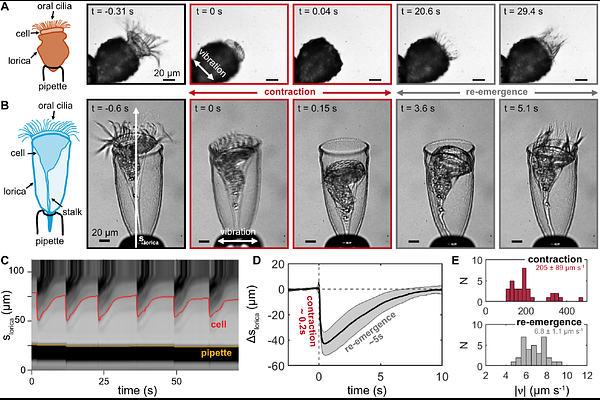
AbstractUnicellular organisms sense, integrate and respond to environmental cues despite lacking neurons or a nervous system. Several species, notably ciliates, are capable of adaptive behaviours normally associated with multicellular animals. Integral to marine ecosystems are planktonic ciliates called tintinnids, which feed on microbes and serve as prey for larger predators. In nature, they swim, feed, hunt, and build ornate loricas, while experiencing varied mechanical and flow perturbations from encounters with other organisms and their environment. Here, we investigated mechanosensory responses in tintinnids at single-cell resolution using temporally controlled touch and vibrational stimuli. Localised touch stimulation of the ciliary band triggered stereotyped ciliary reversals and beat frequency elevation, but strong vibrational stimuli elicited rapid whole-cell contractions. Repeated stimulation produced a progressive decline in response probability that depends on stimulus frequency, with spontaneous recovery if stimulation is withheld. Our work identifies a novel form of cilia-associated habituation response to mechanical stimulation in tintinnids that is distinct from contractile whole-body responses previously reported in other protists. The results show how motility and sensory feedback are tightly coupled to coordinate cellular information processing and a hierarchy of mechanosensory responses in a single-celled organism.