Mutating the interprotofilament interface allows microtubules to assemble in GDP

Mutating the interprotofilament interface allows microtubules to assemble in GDP
Chew, Y. M.; Cross, R. A.
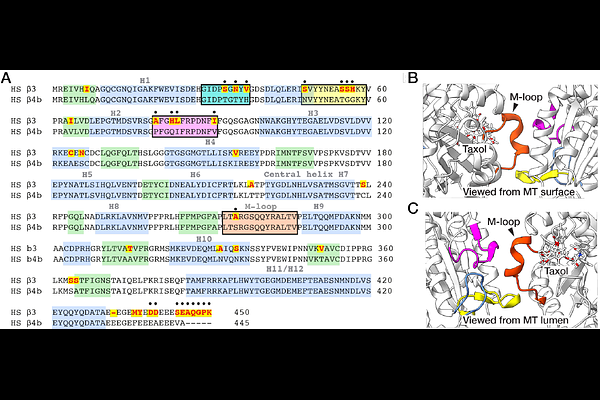
AbstractMicrotubule dynamic instability, driven by GTP turnover, allows microtubules in cells to re-organise themselves adaptively. In some models of dynamic instability, GTP-tubulin is selectively captured at the tips of microtubules. In others, GTP- and GDP-tubulin are both captured, but GTP-tubulin is selectively retained. To investigate, we mutated the interprotofilament interface in human 1b{beta}3 and 1b{beta}4b tubulins, whose sequences diverge markedly in this region. We find that transplanting the 1b{beta}3 M-loop or its binding pocket into 1b{beta}4b tubulin creates tubulins that assemble in 1 mM GDP. In co-assembly experiments in GTP, such hyper-assembler mutants can recruit hypo-assembler mutants into a mosaic lattice, under conditions in which the hypo-assembler alone does not polymerise. We propose that GTP- and GDP-tubulins are captured equivalently at the tips of microtubules, but then differentially retained, based on their differing abilities to form stable interprotofilament bonds. This biased retention mechanism allows mosaic lattices to be built and dynamic instability to be tuned.