Neuroanatomy of the clitoris

Neuroanatomy of the clitoris
Lee, J. Y.; Alblas, D.; Szmul, A.; Docter, D.; Dejea, H.; Dawood, Y.; Hanemaaijer-van der Veer, J.; Bellier, A.; Urban, T.; Brunet, J.; Stansby, D.; Purzycka, J.; Xue, R.; Walsh, C. L.; Lee, P. D.; Tafforeau, P.; Oostra, R.-J.; Kanhai, R. C.; Jacob, J.; van der Post, J. A.; Bleker, O.; Both, S.; Huirne, J. A.; de Bakker, B. S.
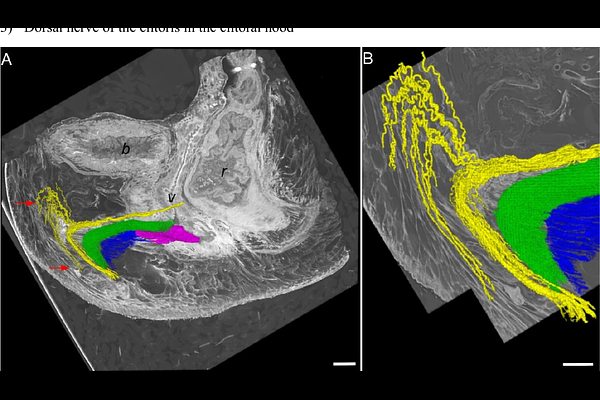
AbstractThe clitoris is one of the least studied organs of the human body. The detailed anatomy of the clitoris is challenging to address through a gross dissection, as most of its parts are embedded internally, surrounded by pubic bone and several pelvic organs. While clinical imaging methods such as magnetic resonance imaging can capture the gross 3D morphology, they lack the spatial resolution required to resolve the detailed structures. In this study, we generated micron-scale computed tomography images of the female pelvises, leveraging a synchrotron radiation X-ray source. This unique data revealed the complex trajectory of the dorsal nerve of the clitoris, the main sensory nerve of the clitoris. Notably, the nerve trunks within the clitoral glans were revealed, with the maximum diameter ranging from 0.2 to 0.7 mm. They showed a tree-like branching pattern projecting towards the surface of the glans. We also revealed that some branches of the dorsal nerve of the clitoris ramify to innervate the clitoral hood and mons pubis. Finally, the posterior labial nerve, a branch of the perineal nerves, was shown to innervate the surroundings of the clitoris and the labial structures. These findings have an immediate impact on operations performed around the vulva area, such as gender-affirmation surgery and reconstruction surgery after genital mutilation.