Substance matters: IL5 and IL33 activation of eosinophils on periostin and fibrinogen induce cytoskeletal reorganization and cell death

Substance matters: IL5 and IL33 activation of eosinophils on periostin and fibrinogen induce cytoskeletal reorganization and cell death
Mitchell, J.; Mosher, D. F.
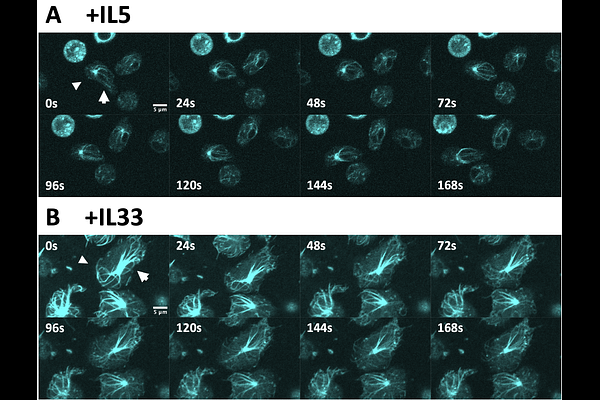
AbstractHuman eosinophils activated in suspension with IL5 or IL33 undergo morphological change prior to adhesion. Refractive granules, which contain major basic protein-1 and other toxic proteins, move to one side of the cell, the granulomere, and the two nuclear lobes move to the other. How these features persist when eosinophils become adherent and migrate is not known. We now compare behavior of activated eosinophils on surfaces coated with ITGAM/ITGB2-integrin ligands fibrinogen or periostin using live cell imaging of reporters of tubulin/actin organization and cell viability. We find that unlike eosinophils activated with IL5, IL33-activated eosinophils undergo two stages of activation; a preliminary pear-like activation in which the cell develops polarity, followed by a flattening of the eosinophil into a thin pancake-like morphology with less discrete polarization. IL5-treated eosinophils migrated persistently for more than an hour with nucleopod in the back. In contrast, IL33-treated eosinophils moved more slowly and within 30 min transitioned to a flattened morphology with nuclear lobes in the center and dispersed motile granules. Loss of cell viability after an hour, although variable, in all comparisons was greater among IL33-treated eosinophils on periostin. We sought to understand how cytoskeletal elements may drive these differences in morphology. Cytoskeletal elements had similar responses when activated with IL5/IL33; vimentin collapsed from a web-like network at the periphery of the cell and condensed adjacent to the nucleopod/nuclear interface, f-actin was found in the granulomere as well as the tip of the nucleopod and forward periphery, and microtubules radiated from the microtubule organizing center (MTOC) spanning both the nucleopod and the granulomere. The dynamic formation of microtubules correlated with cellular locomotion, suggesting mesenchymal migration within these cells. These in vitro findings suggest that adhesion plays an important role in determining functional morphology and demonstrates new insights into IL33-activated eosinophils. This work suggests roles for activators and adhesive substrates in regulating the behavior of activated eosinophils in tissues.