Benchmarking trigonometric continuous-variable gate primitives with trapped ions

Benchmarking trigonometric continuous-variable gate primitives with trapped ions
Tommaso Rainaldi, Jake Montgomery, Christopher G. Yale, Brian K. McFarland, Melissa C. Revelle, Daniel Lobser, Edward C. Tortorici, Susan Clark, George Siopsis, Matt Grau, Felix Ringer
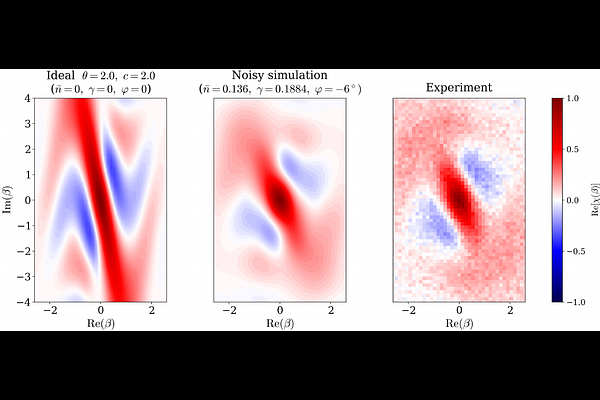
AbstractHybrid continuous-discrete-variable quantum processors can represent bosonic degrees of freedom directly in oscillator modes, or qumodes, while using qubits for control, readout, and nonlinear operations. Recently proposed trigonometric continuous-variable (CV) gate sets promote periodic functions of oscillator quadratures to elementary operations, making them natural primitives for compact variables, rotor models, lattice gauge theories, and anharmonic dynamics. Here we experimentally demonstrate and benchmark one-qumode cosine gates, and perform a mode-resolved marginal benchmark of two-qumode cosine-gate implementations, on the QSCOUT trapped-ion quantum platform. Our implementation uses collective motional modes of three- and four-ion $^{171}{\rm Yb}^{+}$ chains and realizes finite-step trigonometric-gate circuits through hybrid qubit-qumode operations and conditional phase-space displacements. In contrast to previous theoretical and compilation work, we focus on the gate-level characterization of the trigonometric primitives. We measure Fock-space transition probabilities, study their dependence on gate parameters and Trotter step number, and compare with simulations incorporating thermal initialization and motional dephasing. We also derive ideal gate matrix elements and phase-space diagnostics, connecting the measurements to the non-Gaussian structure generated by these gates. These results establish trigonometric CV gates as reusable building blocks for bosonic Hamiltonian simulations and hybrid quantum algorithms requiring intrinsically non-polynomial operations.