Sex-Dependent Effects of Chronic Stress During Adolescence on Cognitive Bias and Functional Connectome in Young Adult Rats

Sex-Dependent Effects of Chronic Stress During Adolescence on Cognitive Bias and Functional Connectome in Young Adult Rats
Dai, T.; Jaeschke-Angi, L.; Penrose-Menz, M.; Rosenow, T.; Rodger, J.
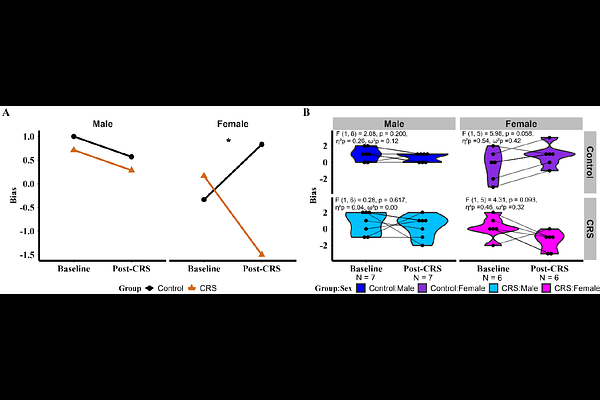
AbstractNegative cognitive biases in depression are more pronounced in females than in males. This sex difference emerges during adolescence, a sensitive developmental stage when chronic stress exposure increases the risk of depression in adulthood. The neurobiology linking adolescent stress to sex-specific cognitive bias and resting-state network reorganization in adults remain poorly understood. The study aimed to investigate the longitudinal effects of chronic restraint stress (CRS) during adolescence on cognitive bias and functional connectome in emerging adulthood. 28 Wistar rats (sex-balanced; aged five weeks on arrival) were trained on a judgment bias task with distinct tactile cues signalling differential rewards. Cognitive bias was quantified from responses to ambiguous probe trials. Following training, animals were randomly and equally assigned to CRS or control groups (sex-balanced). Offline resting-state functional MRI scans were conducted at adolescent baseline (pre-CRS) and again in adulthood (post-CRS), followed by probe trials to assess neural and behavioural changes. Following CRS, females showed a greater tendency to shift toward negative bias than males (ratio of odds ratio=3.67). Furthermore, CRS significantly reduced functional connectivity between the left cerebellar-auditory and hypothalamic-thalamic networks only in females. Repeated-measures correlation between cognitive bias and network connectivity were not statistically significant across sex-by-group strata, potentially due to offline imaging and small sample size. However, intra-individual association revealed sex-specific trends, with CRS females showing moderately positive correlations and CRS males exhibiting a weak negative association. The results could inform stratified connectome-based interventions targeting adolescent stress exposures to potentially reduce the risk of adult depression.