Holographic Quantum Foam: Theoretical Underpinnings and Observational Evidence

Holographic Quantum Foam: Theoretical Underpinnings and Observational Evidence
Eric Steinbring, Y. Jack Ng
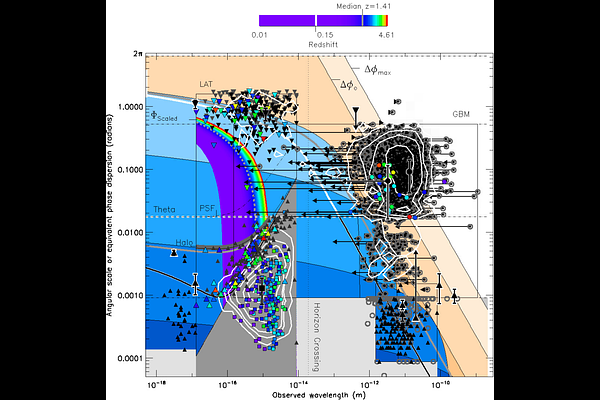
AbstractSpacetime is foamy due to quantum fluctuations. Various gedanken experiments show that distances fluctuate by amounts consistent with the holographic principle, hence the name "holographic quantum foam" (HQF). One important prediction of HQF is that necessarily there exists a dark sector in the universe. The resulting cosmology is found (at least qualitatively) to be consistent with observations. Interestingly the quanta of the dark sector are found not to obey the familiar (fermionic or bosonic) statistics, but the exotic statistics known as infinite statistics (or quantum Boltzmann statistics). The most important challenge now is to check if HQF is consistent with experiments/observations. One way is to look for observational evidence of blurred distant point-sources due to physics at the Planck scale. For over two decades it has been debated whether those tiny inherent uncertainties in time and path-length can accumulate in transiting electromagnetic wavefronts from quasars and Gamma-Ray Bursts (GRBs). But a recent event is special: GRB221009A was extremely bright and energetic. That allowed follow-up across the whole spectrum from the optical/near-infrared through to X-rays, and including the highest-ever-recorded energy gamma-rays; all consistent with blurring by HQF. Those data, and a calculation of the HQF-widened point-spread function (PSF) for real telescopes viewing a GRB are presented.