Post-adiabatic effective-one-body waveforms for coalescing compact binaries

Post-adiabatic effective-one-body waveforms for coalescing compact binaries
Rossella Gamba
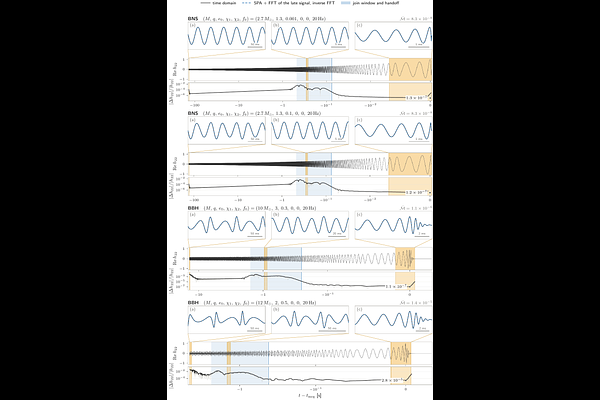
AbstractI apply and extend the formalism of osculating orbits of Damour et al. (2004) and Lynch et al. (2026) to eccentric effective one body (EOB) models, in order to obtain an efficient yet accurate description of the inspiral-to-plunge dynamics of tidal, spinning compact binaries, including precessing ones by twisting the otherwise planar motion. The method is recast in terms of equinoctial orbital elements, to circumvent singularities associated with the zero-eccentricity limit. While the formalism is general and can be applied to any EOB model, I focus here on the TEOBResumS-Dalí family and demonstrate how this technique speeds up waveform generation without significantly compromising the accuracy of the model. Over $10^4$ binary neutron stars (BNSs) and as many binary black holes (BBHs) with initial eccentricities up to $0.6$ at $20$ Hz, the median speedup against an optimized version of the model is $\sim 2.6$ for BNSs and $\sim 1.5$ for BBHs, with mismatches against the full numerical solution always below $5 \times 10^{-7}$. The largest speedups, up to $\sim 7$ for individual systems, are obtained for light BBHs ($M \lesssim 8 M_\odot$) with low eccentricities $(e_0 \lesssim 0.1)$. In absolute terms, the median time needed to generate a BNS waveform is $\sim 0.5$ s, with $99.7\%$ of the systems below one second, and for long signals the model is up to $\sim 26$ times faster than a previous version. Applied to the calculation of initial conditions in the $e \rightarrow 0$ limit, the inclusion of radiation-reaction effects allows the model's input eccentricity to agree with the gauge-invariant waveform eccentricity down to initial values of $\sim 7 \times 10^{-8}$. Beyond time-domain applications, the same construction also gives frequency-domain EOB waveforms for eccentric compact binaries via a multi-harmonic stationary phase approximation.