DARK-HIDE: Dark matter versus hidden dimensions in black hole images

DARK-HIDE: Dark matter versus hidden dimensions in black hole images
Mohsen Fathi
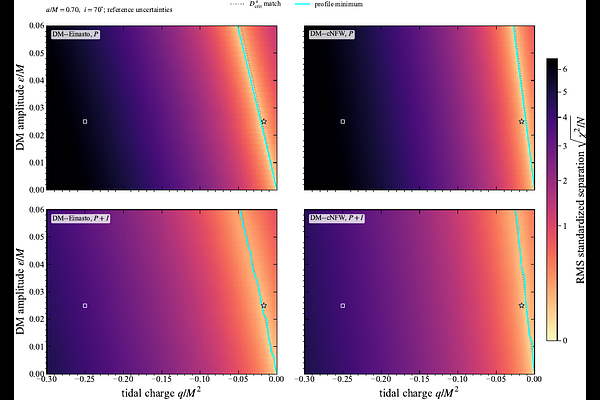
AbstractDark matter near a black hole and effective extra-dimensional corrections can change the same horizon-scale observables. This creates a simple but important question: if an image differs from Kerr, what caused the difference? We study this problem with DARK-HIDE. The dark-matter branch is described by rotating metrics with radial mass functions, while the hidden-dimensional branch is a rotating braneworld metric with a non-electromagnetic tidal charge. We compare photon regions, critical curves, controlled image morphology, a shadow-size likelihood calibrated to EHT results, and local ZAMO escape cones. A strong negative tidal charge is easy to separate from Kerr and from the two benchmark dark-matter profiles. The difficult case appears after the tidal charge is continuously adjusted to mimic the dark-matter critical curve and image proxy. At $\varepsilon/M=0.025$, the best $P+I$ mimics occur at $q/M^2=-0.01917$ for Einasto and $-0.01117$ for cored cNFW, with small standardized separations of $0.084$ and $0.051$. A ray-bundle caustic test does not pass the required convergence and topology checks, so it is excluded from inference. After marginalizing over spin and isotropic inclination, current EHT shadow-size constraints leave both dark-matter amplitudes prior dominated. They mildly suppress large negative tidal charge, but remain fully compatible with $q=0$. Local escape cones retain a small, smooth, and well-resolved difference between the matched branches. Thus, present shadow size alone cannot break the DARK-HIDE degeneracy, while local photon transport keeps additional strong-field information.