Testing the Spatiotemporal Predictions of Global Neuronal Workspace Theory and Integrated Information Theory

Testing the Spatiotemporal Predictions of Global Neuronal Workspace Theory and Integrated Information Theory
Bandara, K. H.; Rowe, E.; Garrido, M.
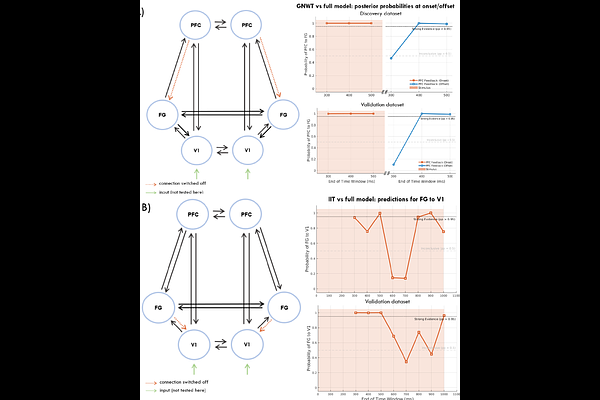
AbstractThe neural mechanisms underlying conscious perception remain contested, with global neuronal workspace theory (GNWT) and integrated information theory (IIT) offering divergent predictions about the spatiotemporal dynamics of conscious processing. The Cogitate Consortium (2025) recently conducted a large-scale adversarial collaboration to arbitrate between GNWT and IIT; however, some of their analyses yielded mixed findings. As the original study relied on functional connectivity, it could not assess the directed neural influences required to directly test the mechanistic claims of these theories. Here, we re-examined the Cogitate Consortium MEG dataset (N = 100) using dynamic causal modelling (DCM) to test the effective connectivity profiles predicted by each theory during task-irrelevant face perception. We adopted a split discovery-validation procedure and an expanding time-window approach to track the temporal evolution of prototypical networks for each theory. Specifically, we evaluated GNWTs prediction of phasic prefrontal ignition by testing the necessity of PFC feedback to category-selective areas at stimulus onset and offset, and then tested IITs prediction of sustained posterior integration by testing extrinsic feedback and intrinsic connectivity within content-specific regions. We found support for both GNWT predictions of prefrontal ignition at stimulus onset and offset; noting that the latter was not previously observed in the original Cogitate analyses. For IIT, whilst feedback connectivity between the fusiform gyrus and primary visual cortex was not sustained throughout the stimulus duration, intrinsic fusiform gyrus connectivity was broadly consistent with IITs prediction of sustained processing within a content-specific substrate. However, a post-hoc validation analysis comparing face- and object-specific DCM networks did not yield strong evidence for face selectivity at any time window (pp< 0.95), warranting a conservative interpretation of the IIT findings in particular.