Effect of Cold Ischemia Time and Fixative preparation on Breast Cancer Biomarker Expression: Implications for Resource-Limited Settings

Effect of Cold Ischemia Time and Fixative preparation on Breast Cancer Biomarker Expression: Implications for Resource-Limited Settings
NDENGUE, C. P.; ATEBA, G. R.; ATANGANA, P. J. A.; MANDENGUE, S. H.; MBOUDOU, E. T.; EBOUMBOU MOUKOKO, C. E.
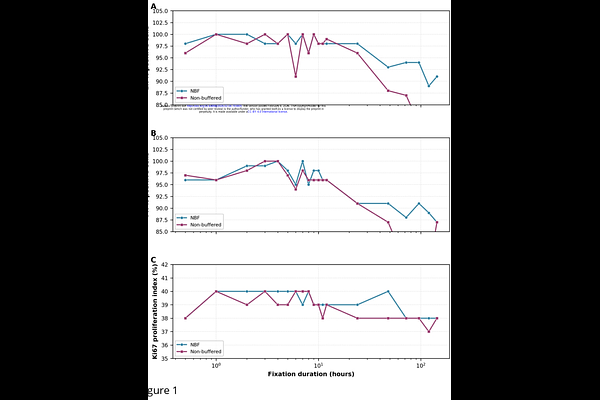
AbstractBackground Optimal pre-analytical management of breast tissue specimens, particularly formalin fixation, is essential for accurate immunohistochemical (IHC) biomarker assessment in invasive breast cancer. Although international guidelines suggest using 4% neutral buffered formalin with controlled fixation time, many laboratories in low-resource settings deviate from these standards. This study aimed to determine whether fixative preparation (4% neutral buffered formaldehyde vs. 4% non-buffered formaldehyde) and cold ischemia time impact the preservation and evaluation of tissue biomarkers in invasive breast cancer. Methods We conducted an experimental study using fresh mastectomy tissue from a 34-year-old patient with invasive ductal carcinoma (pT4, hormone receptor-positive, HER2-negative, Ki67=40%) who had not received neoadjuvant chemotherapy. Fifty microsamples (5-15 mm in length, 1 mm in width) were obtained and divided into four cohorts: (1) 19 samples fixed in 4% neutral buffered formaldehyde for 0.5 to 144 hours; (2) 19 samples fixed in 4% non-buffered formaldehyde for 0.5 to 144 hours; (3) 6 samples with delayed fixation (0.5 to 8 hours) then fixed in neutral buffered formaldehyde for 10 hours; (4) 6 samples with delayed fixation (0.5 to 8 hours) then fixed in non-buffered formaldehyde for 10 hours. Hormone receptors (estrogen receptor-ER, progesterone receptor-PR) and Ki67 expression were evaluated by IHC using the Allred scoring system and current international recommendations. Results Fixative preparation had a statistically significant, yet minimal, biological impact on biomarker evaluation. The mean percentage of ER-positive cells was 96.89{+/-}0.74% with neutral buffered formaldehyde compared to 94.32{+/-}1.51% with non-buffered formaldehyde (p=0.011). Similar trends were seen for PR (94.89{+/-}0.95% vs. 92.63{+/-}1.67%, p=0.027) and staining intensity. However, Allred scores remained constant. Cold ischemia time was strongly correlated with decreased biomarker expression regardless of fixative preparation. Hormone receptor expression and Ki67 remained stable with minimal Allred score changes for up to 2 hours of cold ischemia, but significantly decreased after 2 hours, with scores decreasing in proportion to the duration of ischemia (p<0.05). Conclusions Non-buffered formaldehyde preserves tissue biomarkers almost as effectively as neutral buffered formaldehyde for IHC analysis. Following guidelines, a cold ischemia time of up to 1 hour is still a wise standard to guarantee accurate biomarker assessment. These results are significant for pathology laboratories in resource-limited settings where neutral buffered formalin may not be easily accessible.