Single-cell chromatin profiling reveals dynamic regulatory logic and enhancer elements in brain and retina development

Single-cell chromatin profiling reveals dynamic regulatory logic and enhancer elements in brain and retina development
Greenslade, J. E.; Veeravenkatasubramanian, H.; Reed, M. L.; Raj, B.
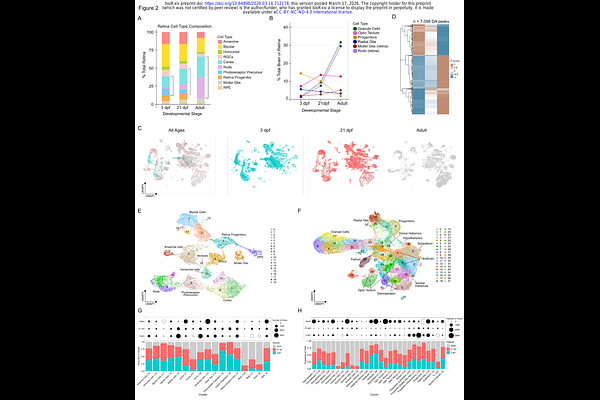
AbstractCell type identity in the nervous system is encoded within cis-regulatory landscapes that integrate transcription factor activity with chromatin accessibility. However, how these regulatory programs are organized and remodeled during post-embryonic neural development is poorly understood. We generate a temporally resolved single-cell chromatin accessibility atlas of ~95,000 zebrafish brain and retina nuclei spanning larval, juvenile, and adult stages. We define 212 discrete chromatin states and uncover widespread, cell type-specific chromatin reorganization across development. By integrating with transcriptomic data, we link motif accessibility to transcription factor expression and identify regulatory programs that are either maintained or reconfigured during post-embryonic development of each neural cell type. Leveraging this atlas, we systematically identify and functionally validate candidate enhancers in vivo. Focusing on the slc1a3b locus in radial glia, we define evolutionarily conserved, compact enhancer modules that act combinatorially to drive gene expression. Together, these findings provide a systems-level framework for decoding neural regulatory logic and enable functional dissection of conserved cis-regulatory programs in the vertebrate nervous system.