Inspirals into bosonic dark matter stars and chirp mimickers

Inspirals into bosonic dark matter stars and chirp mimickers
Caio F. B. Macedo, Haroldo C. D. Lima, Raissa F. P. Mendes, Rodrigo Vicente, Vitor Cardoso
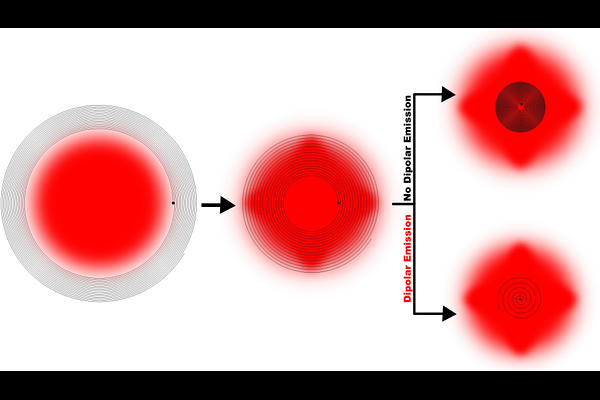
AbstractWe investigate extreme-mass-ratio inspirals in which a stellar-mass compact object orbits a supermassive bosonic dark matter star, modeled as a boson star, using fully relativistic perturbative methods. Unlike inspirals around electro-vacuum black holes, these systems can shed scalar matter through dynamical friction which significantly alters the inspiral dynamics. We show that this additional dissipation can induce a chirp-like gravitational-wave signal closely resembling that of black hole binaries, allowing boson stars to act as gravitational-wave chirp mimickers even when they are not ultracompact. The inspiral evolution and resulting waveform depend sensitively on the compactness of the central boson star: highly compact configurations trigger dipolar scalar radiation, leading to a rapid plunge, whereas less compact stars yield smoother inspirals dominated by gravitational and quadrupolar scalar waves. To support waveform modeling, we derive semi-analytical prescriptions for the gravitational and scalar energy fluxes that remain accurate deep into the relativistic regime. Our findings indicate that future space-based detectors such as LISA could distinguish these mimicker signals from true black hole inspirals through measurable phase dephasings induced by scalar dissipation.