A meta-analysis of chromatin-associated loci provides insights into mechanistic interpretations of trait heritability

A meta-analysis of chromatin-associated loci provides insights into mechanistic interpretations of trait heritability
Dudek, M. F.; Wenz, B. M.; Voight, B. F.; Almasy, L.; Grant, S. F. A.
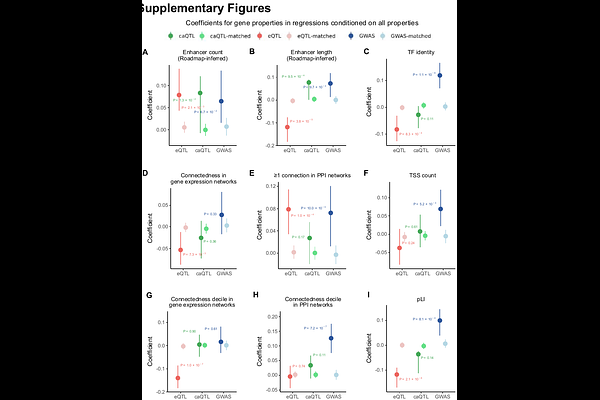
AbstractThe vast majority of trait-associated loci discovered through genome-wide association studies (GWAS) are non-coding, yet most lack statistical alignment with any discovered expression quantitative trait loci (eQTLs). In particular, eQTLs are depleted at gene-distal regions and at "functionally important" genes - those with strong selective constraint and complex regulatory landscapes - likely due to selective depletion of high-effect variants. Here, we investigate the role of variants with weaker effects on expression transmitted through distal regulatory elements, which are detectable as chromatin accessibility QTLs (caQTLs). We aggregated caQTL data from ten studies derived across different tissues, cell-types and lines, representing 104,024 lead caQTLs across 3,457 samples. We found that, across a range of gene properties, caQTLs are discovered at functionally important genes more often than eQTLs. These observations are consistent with a model in which many eQTLs and GWAS hits are mediated through genetic effects on regulatory elements, which may have weak or context-dependent effects on gene expression. Our results suggest that caQTL discovery is more sensitive than eQTL discovery in capturing the molecular consequences of GWAS hits, and can provide complimentary information to eQTLs by implicating functional mechanisms of additional disease-associated loci.