Contribution of Wide Dynamic Range neuronal activation to somatosensory evoked potentials supports use as biomarker of spinal nociceptive processing

Contribution of Wide Dynamic Range neuronal activation to somatosensory evoked potentials supports use as biomarker of spinal nociceptive processing
Steel, K. A. J.; Pickering, A. E.; Dunham, J. P.; Ajay, E.; Krajewski, J.; Blockeel, A.; Phillips, K. G.
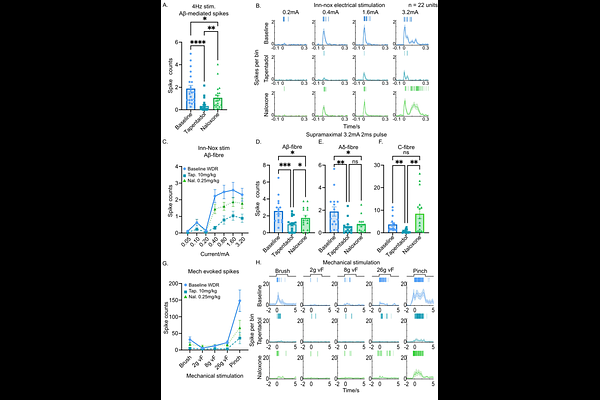
AbstractIdentifying objective translational biomarkers of spinal nociceptive processing is important to accelerate analgesic development. The primary negative component (N1) of spinal somatosensory evoked potentials (SEPs) has been proposed as such a biomarker. However, the cellular substrates of the N1 potential (evoked by innocuous electrical stimulation) and their relevance to nociceptive processing have not been directly demonstrated. Here, we employed a 64-channel multielectrode recording approach in the dorsal horn of anaesthetised Wistar rats to functionally characterise the neuronal populations activated during the generation of spinal SEPs and determine how their activity is modulated by tapentadol. Single units were classified based on their responses to mechanical stimulation of the hindpaw, and their electrically evoked responses to sciatic nerve stimulation. Of 59 well-isolated units, 47 (80%) were classified as wide dynamic range (WDR) neurons and 12 (20%) as low-threshold mechanoreceptive (LTMR) neurons, spatially distributed across spinal laminae III-V. Tapentadol (10 mg/kg, intraperitoneal (i.p)) selectively attenuated the mechanically- and electrically-evoked activity of WDR neurons without affecting LTMR responses. This WDR-inhibition was largely reversed by naloxone (0.25 mg/kg, i.p) but not by atipamezole (1 mg/kg, i.p), identifying a predominant opioid receptor-mediated mechanism of inhibition in the naive state. The magnitude of WDR inhibition by tapentadol correlated with the degree of reduction of the N1 amplitude. These findings establish activity in WDR neurons as a core component of the N1 potential, supporting the use of spinal SEPs as a translational biomarker of analgesic target engagement within the dorsal horn.