Cardiac signals shape insular cortex activity and emotion coding

Cardiac signals shape insular cortex activity and emotion coding
Malezieux, M.; Yeongseok, J.; Ressle, A.; Schmid, B.; Gogolla, N.
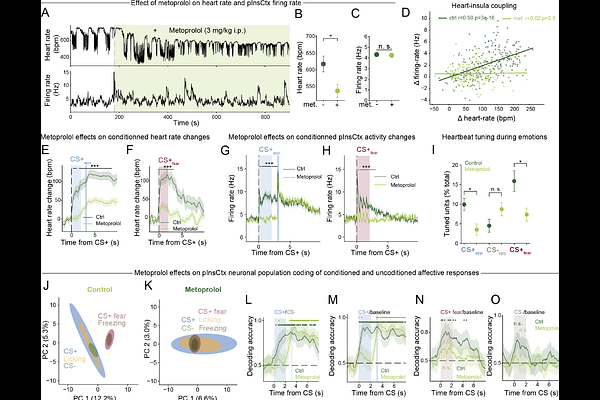
AbstractAccumulating evidence suggests that cardiac information influences neuronal activity and fundamental brain functions across species. Yet, how the brain represents cardiovascular signals and how this may impact the processing of emotion states remains unclear. Here, we show that intracellular dynamics and single unit activity in the posterior insular cortex (pInsCtx) are precisely regulated by cardiac signals, with individual neurons tuned to heartbeats in a frequency-dependent manner. Furthermore, heartbeat tuning in the pInsCtx occurred preferentially during the first phase of the cardiac cycle, at systole. Heartbeat tuning increased during both appetitive and aversive emotion states, a process not simply explained by increases in heart rate. Manipulation of sympathetic cardiac arousal using beta-adrenergic blockade disrupted neuronal encoding of emotion states in the pInsCtx and blunted behavioral and bodily emotion expression. These findings reveal precise sensory coding of cardiovascular signals in the pInsCtx, which supports its role in encoding emotion states.