Dichloroacetate improves animal survival, growth, neuromuscular activity, mitochondrial stress and physiology, and elevated lactate in C. elegans pdha-1 and dld-1 RNAi models of pyruvate dehydrogenase complex deficiency (PDCD)

Dichloroacetate improves animal survival, growth, neuromuscular activity, mitochondrial stress and physiology, and elevated lactate in C. elegans pdha-1 and dld-1 RNAi models of pyruvate dehydrogenase complex deficiency (PDCD)
Remes, C.; Mathew, N. D.; Miranda, V.; Haroon, S.; O'Hara, T.; Anderson, V. E.; Lavorato, M.; Keith, K.; Xiao, R.; Nakamaru-Ogiso, E.; Falk, M. J.
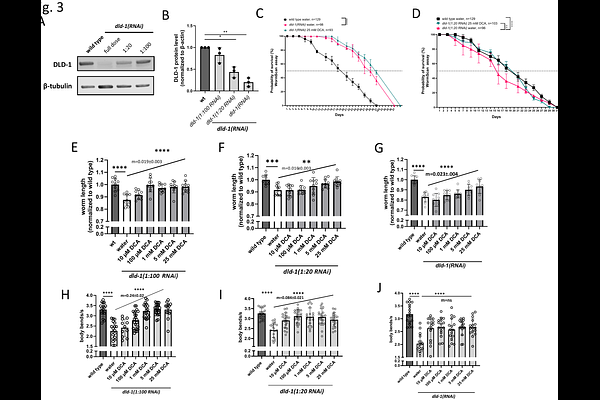
AbstractPyruvate dehydrogenase complex (PDHc) deficiency (PDCD) is a primary mitochondrial disorder characterized by neurodevelopmental disability, altered intermediary metabolism and early mortality. Dichloroacetate (DCA), a pyruvate analogue, is a well-described PDHc activator that remains under clinical investigation for treatment of PDCD. Here, we studied the in vivo efficacy of a 5-point log concentration range of DCA on animal health and metabolism in C. elegans with feeding RNA interference (RNAi) expression knockdown of either PDHA-1 or DLD-1 homologues at graded degrees to model variable disease severity. These worm models recapitulate phenotypic features of PDCD observed in human patients, including reduced survival, delayed growth, locomotor impairment, and elevated lactate and/or pyruvate tissue levels. DCA treatment appeared well-tolerated, with no gross morphologic toxicity seen at doses up to 25 mM. Significantly improved health, survival, tissue lactate levels, and mitochondrial physiology were observed at 25 mM in pdha-1(RNAi) knockdown animals. DCA treatment in dld-1(RNAi) C. elegans models (undiluted, 1:20 dilution, and 1:100 dilution) showed significant therapeutic benefits on survival, neuromuscular function and metabolic phenotypes primarily in the moderate (1:20) and/or mild (1:100) dld-1(RNAi) deficiency strains, but not in full-dose dld-1(RNAi). Importantly, linear growth, neuromuscular activity, and mitochondrial physiology were significantly improved with DCA treatment even in the most severe dld-1(RNAi) undiluted model. Overall, preclinical modeling provides objective evidence of DCA therapeutic efficacy in C. elegans expression knockdown strains for two well-conserved homologues of PDHA1 and DLD that represent distinct genetic etiologies of PDHc deficiency, with demonstrated beneficial effects on survival, healthspan, tissue lactate, and mitochondrial physiology. These data further confirm that DCA's therapeutic effect correlates with PDHc disease phenotype severity in dld-1(RNAi) animals.