Matrix stiffness shifts the endothelial shear stress set point for angiogenic activation

Matrix stiffness shifts the endothelial shear stress set point for angiogenic activation
Gifre-Renom, L.; Tabibian, A.; Giese, W.; Bellen, F.; Luttun, A.; Van Oosterwyck, H.; Jones, E. A. V.
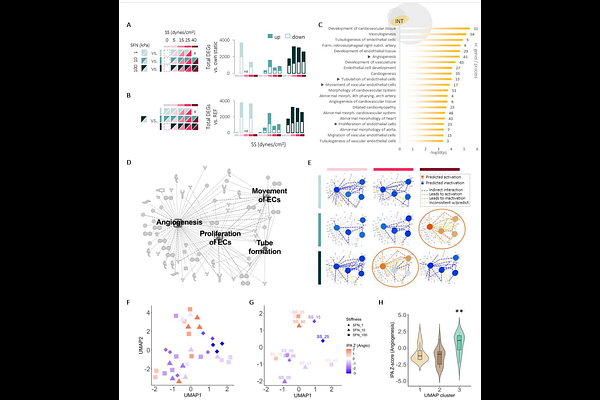
AbstractAims: Endothelial cells (ECs) are simultaneously exposed to wall shear stress (SS) from blood flow and substrate stiffness (SFN) from the extracellular matrix, yet how these cues are integrated to shape endothelial behavior remains incompletely understood. We applied an unbiased transcriptomics strategy to define how SS and substrate SFN jointly encode endothelial state transitions and determine angiogenic activation thresholds. Methods and Results: We generated a factorial RNA-Seq dataset of human ECs exposed to 14 combinations of SS (0-40 dynes/cm2) and SFN (1-100 kPa). DESeq2 with likelihood ratio testing identified genes whose expression was significantly associated with SS, SFN, or their interaction. SS was the dominant driver of global transcriptional variation and elicited non-linear transcriptional responses, whereas substrate SFN had a smaller direct effect but significantly modulated the endothelial response to flow. Interaction analyses identified gene programs associated with vascular remodeling, including angiogenesis and migration. Pathway-level analyses revealed that substrate SFN shifts the SS threshold at which angiogenic transcriptional programs become activated, indicating that SFN tunes the endothelial angiogenic set point rather than scaling the response magnitude. Moreover, activated states differed qualitatively across mechanical contexts, reflecting context-dependent reweighting of shared inflammatory, stress, and adaptive/remodeling programs. Finally, siRNA-mediated YAP1 knockdown confirmed its contribution to SS-SFN-dependent gene regulation. Conclusion: This study provides a systems-level experimental and bioinformatic framework for disentangling multifactorial mechanotransduction in ECs. Although SS predominates in shaping endothelial transcriptomes, substrate SFN critically modulates how ECs interpret flow by shifting the threshold for angiogenic transcriptional activation and reweighting downstream pathways.