Myeloid DRP1 Sulfenylation Drives Reparative Macrophage Polarization and Neovascularization in Ischemic Muscle

Myeloid DRP1 Sulfenylation Drives Reparative Macrophage Polarization and Neovascularization in Ischemic Muscle
Yadav, S.; Nagarkoti, S.; Sudhahar, V.; Rajagopal, K.; Das, A.; Spears, S. K.; Fukai, T.; Ushio-Fukai, M.
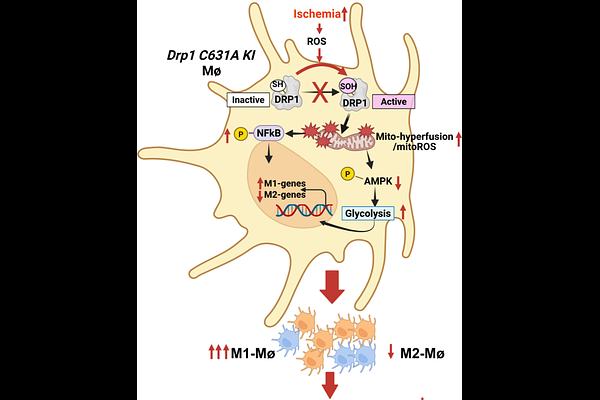
AbstractReparative macrophage polarization and macrophage-derived reactive oxygen species (ROS) are required for ischemia-induced revascularization in peripheral artery disease (PAD). Our previous study showed that mitochondrial fission protein DRP1 promotes reparative polarization and metabolic reprogramming in macrophages and post-ischemic neovascularization. However, the redox-dependent mechanism governing DRP1 activation in this context remains elusive. Here, using a mouse hindlimb ischemia (HLI) model of PAD, we identify cysteine sulfenylation (CysOH) of DRP1 as a critical redox modification induced in ischemic bone marrow (BM)-derived cells. BM chimeric mice reconstituted with CRISPR/Cas9-generated, redox-dead DRP1-C631A knock-in mutant (Drp1C/A) BM exhibited markedly reduced limb perfusion recovery and CD31+ capillary density in ischemic muscles following HLI. These defects were associated with enhanced Ly6G+ neutrophil accumulation, pro-inflammatory F4/80+CD80+ M1 macrophages and reduced anti-inflammatory F4/80+CD206+ M2 macrophages in ischemic muscle. Mechanistically, using an in vitro PAD model, hypoxia-serum starvation (HSS) rapidly induced cytosolic ROS production and DRP1-CysOH formation in wild type macrophages. In contrast, Drp1C/A macrophages failed to undergo DRP1-CysOH-dependent mitochondrial fission under HSS, resulting in aberrant metabolic reprogramming characterized by enhanced glycolysis and mitochondrial ROS, pro-inflammatory p-NF-kB and M1-genes, and suppressed anti-inflammatory p-AMPK and M2-genes. Thus, our findings establish DRP1 sulfenylation as a previously unrecognized redox-sensing mechanism that links ischemia-induced ROS to reparative macrophage reprogramming and revascularization, identifying a novel therapeutic target for PAD.