String-inspired Gauss-Bonnet Gravity Inflation and ACT

String-inspired Gauss-Bonnet Gravity Inflation and ACT
S. D. Odintsov, V. K. Oikonomou, Pyotr Tsyba, Olga Razina, Dauren Rakhatov
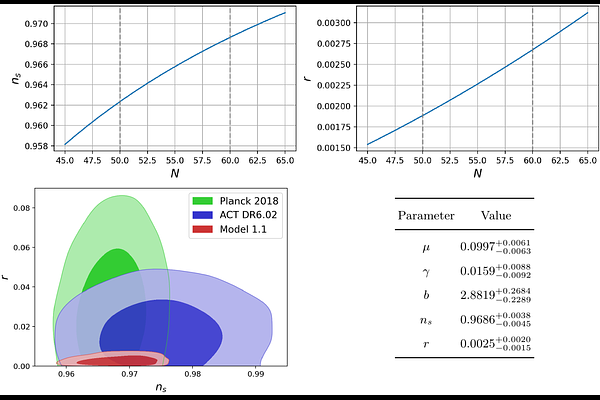
AbstractIn this article we present a systematic observational verification of the ghost-free string-inspired $f(R,\mathcal{G})$ model, where the Gauss-Bonnet invariant is non-minimally coupled to an auxiliary scalar field $χ$ through the coupling function $h(χ)$. Previous studies confirmed the theoretical viability of this framework using phenomenological parameter choices. In this work, for the first time, a systematic comparison with observational data from Planck 2018 and the Atacama Comsology Telescope is carried out via a Bayesian MCMC analysis using the Cobaya code. We explore an extended set of sixteen models constructed from four types of the Hubble parameter combined with power-law, exponential, hybrid, and inverse logarithmic coupling functions $h(χ)$. The hybrid coupling $h(χ) = γe^{b_1χ}χ^{b_2}$, introduced in this context, allows for interpolation between the power-law and exponential forms, providing additional flexibility in controlling the Gauss-Bonnet contribution at different stages of inflation. All sixteen models reproduce the red spectral tilt of scalar perturbations consistent with CMB observations, yielding $n_s \approx 0.97$ at $N = 60$ e-folds. We find that the preference for the dataset is systematically determined by the choice of Hubble parametrization rather than by the coupling function. The parameter $μ\approx0.1$ remains stable in all configurations, suggesting its fundamental role within the ghost-free formalism.