Case studies with GPBilby of glitch-contaminated transient gravitational waves

Case studies with GPBilby of glitch-contaminated transient gravitational waves
Mattia Emma, Ann-Kristin Malz, Adriana Dias, Gregory Ashton
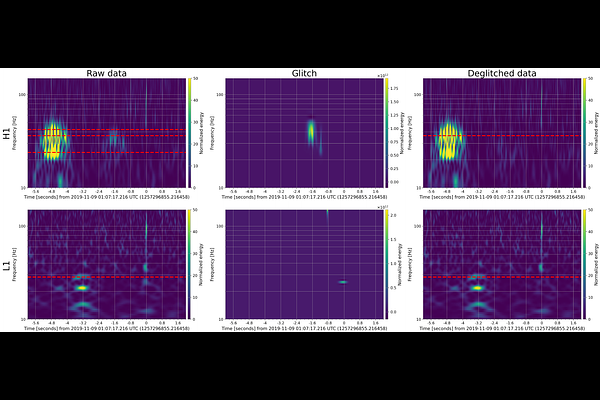
AbstractIn their fourth observing run, the LIGO--Virgo--KAGRA gravitational-wave observatories have found hundreds of new signals, but many are contaminated by non-Gaussian transient noise artefacts known as glitches. Left unaddressed, glitches can bias parameter inference and lead to misleading astrophysical conclusions. We present a series of case studies using GPBilby, a parameter estimation tool that employs a time-domain likelihood jointly modelling the astrophysical signal with a physical waveform and non-Gaussian noise with a Gaussian process. We first show that when the detector noise is Gaussian, GPBilby produces results consistent with those obtained with the standard Gaussian-noise likelihood, and then consider events affected by non-Gaussian features. For GW231123, the highest-mass binary black hole candidate observed to date, analyses using IMRPhenomXPHM reveal coherent residual structure that leads to measurable shifts in inferred source parameters. In contrast, analyses employing NRSur7dq4 show no significant excess residual power and remain consistent across likelihood choices. This demonstrates that waveform systematics and flexible noise modelling are intrinsically coupled, as the Gaussian process terms can partially absorb coherent waveform mismatches. For GW191109, we find that evidence for spin misalignment remains robust despite glitches in both LIGO detectors. For GW230630_070659, excluded from GWTC-4.0 owing to poor data quality, we find the data to be consistent with a BBH waveform model, with no additional residual power identified by the Gaussian process component. Overall, these results highlight how GPBilby can be used to perform glitch-robust inference and as a tool to understand waveform modelling systematics.