A 3D printed model of human lactation

A 3D printed model of human lactation
Hasenauer, A.; Zenobi-Wong, M.
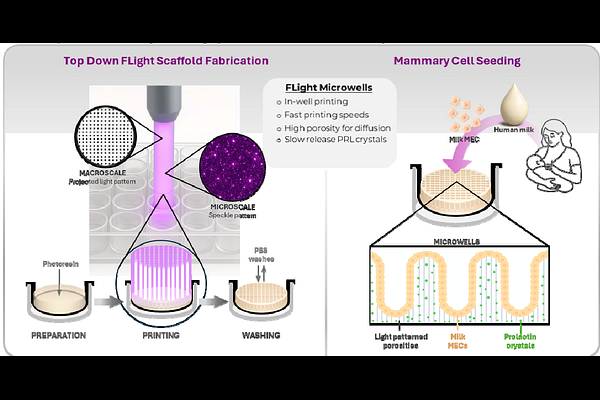
AbstractEngineering physiologically relevant breast in vitro models remains challenging due to the gland's complex three-dimensional microanatomy, together with the need for epithelial polarity and hormone responsiveness. To overcome these challenges, fabrication methods are needed that rapidly create alveoli-scale structures with efficient diffusion and sustained hormonal stimulation. Here, Filamented Light (FLight) biofabrication is leveraged to print highly porous, ECM-based hydrogel scaffolds directly within standard Transwell inserts with separate apical and basal access. FLight's speckle-patterned laser generates multiscale scaffold architectures that integrate filament-derived microchannels (~15 um) to promote diffusion with alveoli-inspired cylindrical microwell arrays (100,150, 200 um) that impose geometric constraints to guide epithelial organization. Each insert is printed in <10 s and incorporates slow-release prolactin microcrystals to provide lactogenic stimulation in situ. Primary human milk-derived mammary epithelial cells (milk MECs) were seeded onto the constructs. There, milk MECs line the printed microwells, establish zona occludens-1-positive tight junctions, and express lactation-associated markers (prolactin receptor and beta-casein), alongside milk fat globules and intracellular lipid droplets. Collectively, this rapidly reconfigurable FLight platform enables high-throughput generation of hormone-responsive human mammary microtissues for lactation-focused studies and is adaptable to other lumen-forming epithelia.