Free-flight kinematics of soldier flies during headwind gust perturbations

Free-flight kinematics of soldier flies during headwind gust perturbations
Gupta, D.; Sane, S. P.; Arakeri, J. H.
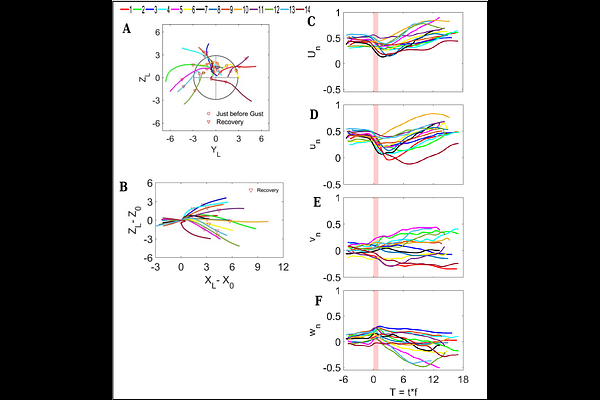
AbstractLarge commercial and military aircraft can operate in a wide range of turbulent conditions, except during extreme weather events such as cyclones. Smaller man-made vehicles, such as micro aerial vehicles (MAVs) and nano aerial vehicles (NAVs), are significantly more sensitive to routine environmental wind fluctuations, making them difficult to control. In contrast, insects exhibit remarkable stability in naturally gusty conditions. Despite this, few studies have systematically investigated the impact of gusts and turbulence on insect flight performance. To address this gap and to gain fundamental insights into insect flight stability under gusty conditions, we examined the flight of freely flying black soldier flies subjected to a discrete head-on aerodynamic gust in a controlled laboratory environment. Flight motions were recorded using two high-speed cameras, and body and wing kinematics were analyzed across 14 distinct cases. In response to the gust, we observed consistent features across the cases: (1) asymmetry in wing stroke amplitude, (2) large changes in body roll angle, up to 160 deg, occurring over approximately two wing beats (~20 ms) with recovery over ~9 wing beats, (3) transient pitch-down attitude, and (4) deceleration in the flight direction. These rapid responses, combining passive and active control mechanisms, provide insight into the flight control strategies employed by insects. The findings offer valuable guidance for the design of MAVs and NAVs capable of robustly responding to gusts and unsteady airflow in natural environments.