Exosome-mediated LNA anti-miR delivery achieves potent miR-21 inhibition and PTEN restoration in podocytes.

Exosome-mediated LNA anti-miR delivery achieves potent miR-21 inhibition and PTEN restoration in podocytes.
Lange, T.; Soh, J. E. C.; Friedrich, L.-K.; Goetsch, P. L.; Weber, C.; Biedenweg, D.; Schlueter, R.; Janke, U.; Delcea, M.; Endlich, N.
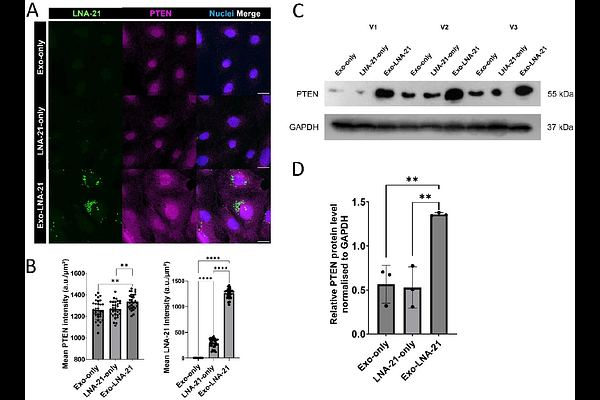
AbstractBackground Podocyte injury and loss are central drivers of chronic kidney disease (CKD) progression and are involved in the majority of glomerular diseases. Among the molecular pathways implicated in podocyte dysfunction, microRNA-21 (miR-21) is consistently upregulated during glomerular injury and suppresses protective target genes including PTEN. Although anti-miR-21 approaches have shown high efficacy in preclinical models for Alport Syndrome and diabetic nephropathy, clinical translation of free anti-miR-21 oligonucleotides remains challenging, potentially reflecting limited glomerular and podocyte target engagement. Here, we show that an exosome-mediated delivery of a LNA-miR-21 inhibitor results in a higher intracellular uptake, leading to functional miR-21 inhibition and PTEN restoration in podocytes. Methods Exosomes were isolated from immortalized murine podocytes SVI and were directly loaded with fluorescently-labeled LNA anti-miR-21 (LNA-21) and anti-miR-Ctrl. Exosome integrity was assessed by transmission electron microscopy, dynamic light scattering and Western blot analysis of CD9 and TSG101. Uptake efficiency and intracellular delivery were analyzed by confocal laser-scanning microscopy, time-series imaging (2-48 h) and (imaging) flow cytometry. Functional efficacy was evaluated by TaqMan RT-qPCR and PTEN protein expression in differentiated SVI podocytes, primary murine podocytes and puromycin aminonucleoside (PAN)-injured primary glomeruli. Results Exosome number, morphology and marker expression remained unchanged after direct LNA-miR-21 loading. Time-series imaging demonstrated progressive intracellular accumulation of exosome-delivered LNA-21 cargo from 2 to 48 h, whereas free LNA-21 showed no detectable uptake. Flow cytometry and imaging flow cytometry confirmed an efficient (76.6%) intracellular delivery exclusively via exosomes. Exosome-mediated LNA-21 delivery induced a robust miR-21 suppression, resulting in an 99% reduction in immortalized podocytes, a 97% reduction in primary podocytes and a 97% reduction in PAN-injured glomeruli (all p < 0.05). In contrast, free LNA-21 did not achieve significant suppression in all investigated models. To evaluate the functional consequences of miR-21 inhibition, we examined PTEN expression, as PTEN is a known direct target of miR-21. Notably, restoration of PTEN protein expression was observed only following exosome-mediated LNA delivery which was confirmed by Western blot and immunofluorescence, suggesting efficient functional inhibition of miR-21 in podocytes. Transfection of scrambled controls confirmed sequence specificity throughout. Conclusion These findings demonstrate that exosome-mediated LNA delivery overcomes the limited uptake of free inhibitor oligonucleotides in podocytes and enables functional inhibition of miR-21 across multiple experimental systems. These data provide mechanistic proof-of-principle for exosome-based miR inhibitor delivery as a potential strategy to improve podocyte-targeted therapies in CKD.