The two shadows of a single black hole: Vacuum birefringence phenomena within Einstein-Nonlinear-Electrodynamics

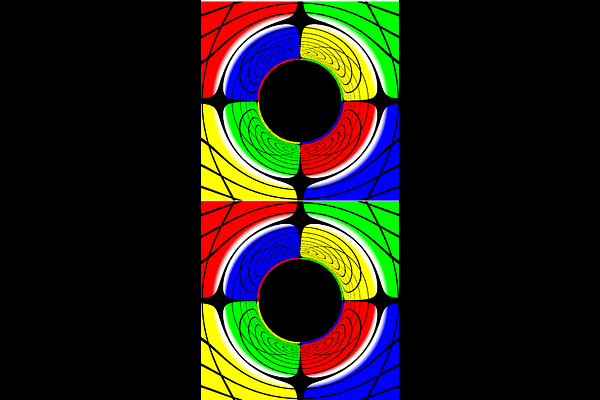
The two shadows of a single black hole: Vacuum birefringence phenomena within Einstein-Nonlinear-Electrodynamics
Marco A. A. de Paula, Haroldo C. D. Lima, Pedro V. P. Cunha, Carlos A. R. Herdeiro, Luís C. B. Crispino
AbstractOne of the main features of nonlinear electrodynamics (NED) is the existence of an effective geometry that describes the geodesic motion of photons. A detailed analysis of the properties of effective geometry is of utmost importance for a better understanding of NED theories and their possible imprints on physics, especially in the context of black holes (BHs). We consider a NED model that depends on the two electromagnetic scalar invariants and obtain that the motion of photons in NED exhibits \textit{vacuum birefringence}, i.e., photons can propagate along two distinct paths, depending on their polarization. As a consequence of this phenomenon, we show that static black hole solutions sourced by NED can admit two distinct unstable light rings, leading to the formation of two distinct shadows. Moreover, to explore the potential astrophysical relevance of our results, we also compare them with the astrophysical observations for the shadow radius of Sagittarius A*. We place upper limits on the charge-to-mass ratio of the NED-sourced black hole. We also show that the motion of photons in this context can be interpreted as nongeodesic curves subjected to a four-force term from the perspective of an observer in the spacetime metric, generalizing previous results in the literature for NED models that depend on a single electromagnetic scalar invariant.