A Phospho-Switch for Cell Fate Control

A Phospho-Switch for Cell Fate Control
ming, j.; liu, x.; jia, z.; shi, w.; li, j.; wang, s.; chen, y.; lin, s.; liang, y.; guo, p.; zhao, h.; yao, y.; shi, r.; zhang, x.; shan, y.; fu, y.; wang, b.; zhao, c.; Pei, D.
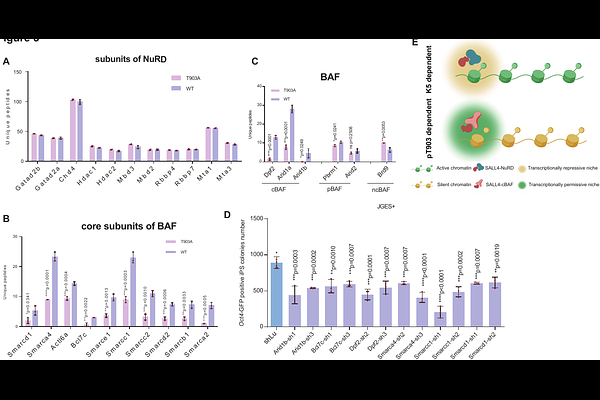
AbstractCell fate control is thought to be complex, likely involving both cell intrinsic and extrinsic factors, and remains ill-defined at the molecular level. Here we show a phospho-switch controls cell fate both in vitro and in vivo. We first show that SALL4 is phosphorylated at multiple sites, but only T903 as the primary one as SALL4T903A lost BAF interaction and ~90% activity in reprogramming. Mechanistically, we demonstrate that SALL4pT903 is sensitive to BMP4 signaling through DUSP9 axis. Finally, we show by tetraploid embryo complementation that mESCs harboring SALL4T903A can sustain embryo development but with severe defects including cranial hypoplasia and flattened skull vault after birth. A genome wide search identifies 608 transcription factors harboring the same HTG motif sandwiched by two zinc fingers, suggesting that this phospho-switch may be a conserved mechanism to control cell fate.