Habitat fragmentation controls bacterial community composition outcomes

Habitat fragmentation controls bacterial community composition outcomes
Batsch, M.; Puzyrko, A.; Guex, I.; van der Meer, J. R.
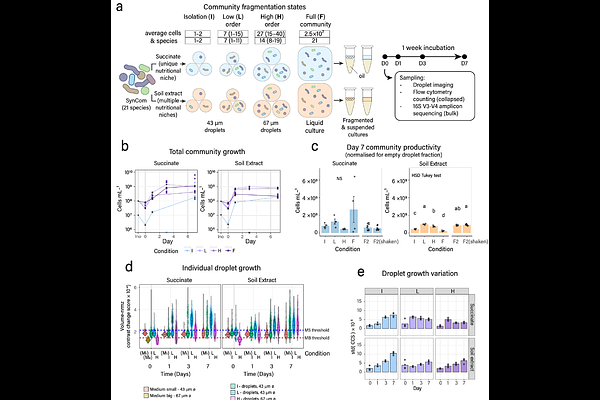
AbstractNatural habitats of bacteria are often highly structured in space, but how this affects their interactions and community composition outcomes is poorly understood. To address this gap, we studied the development of a synthetic soil community of 21 bacterial strains under a gradient of habitat fragmentation on single or mixed-substrate conditions. Fragmentation was produced by random microfluidic seeding of the mixed inoculum into culture medium droplets of variable volume (30-150 pL), targeting mean starting densities between 1 and 27 founder cells comprising 1-2, 7 or 14 taxa per droplet. Across all droplets for each of the fragmented states, globally different community compositions arose, suggesting variable individual taxa strategies and adaptation to differences in habitat fragmentation. In comparison to the same mixed inoculum growing under the same nutrient conditions in bulk culture, the more fragmented conditions allowed higher cell density and diversity, with less overgrowth by a few strains. Community evenness was highest when inocula were dispersed into individual taxon (1-2 taxa) or low-order combinations (7 taxa per droplet), but individual dispersion reduced the productivity of the meta-community across droplets. Monod-type simulations suggested that most community composition could be explained by the inherent individual kinetic properties and dispersal constraint effects of the fragmented habitat, with smaller effects from emerging interspecific interactions. Overall, our results show the strong effect of habitat structure on community outcomes, with higher fragmentation states favoring more even species coexistence.