Longitudinal spatial profiling of neutrophils during adoptive T cell therapy in murine melanoma reveals distinct lymph node infiltration patterns across anatomical sites

Longitudinal spatial profiling of neutrophils during adoptive T cell therapy in murine melanoma reveals distinct lymph node infiltration patterns across anatomical sites
van der Voort, G.; Effern, M.; Yong, M. C. R.; Kiwitz, L.; Turiello, R.; Leonardelli, S.; Ng, S.; Corvino, D.; Bald, T.; Glodde, N.; Thurley, K.; Hasenauer, J.; Hölzel, M.
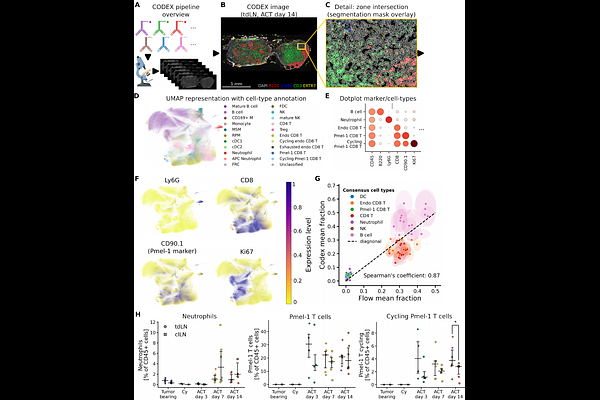
AbstractReactive neutrophil infiltration can restrain CD8+ T cell expansion in lymph nodes during adoptive T cell therapy (ACT), yet its spatiotemporal regulation remains incompletely understood. Levaraging flow cytometry and multiplex immunofluorescence data, we performed a time-resolved quantitative assessment of immune cell dynamics in tumor-draining lymph node (tdLN) and non-tumor-draining lymph node (non-tdLN) in a melanoma mouse model receiving ACT. Transferred tumor-reactive CD8+ T cells accumulated and expanded early after treatment initiation, showing the highest frequency of a favorable central memory CD8+ T cell phenotype in the tdLN. Enhancing innate immune signaling in melanomas increased neutrophil influx into lymph nodes, particularly the non-tdLN; however, within the tdLN, neutrophils were enriched in the T cell zone, which also contained the largest absolute reservoir of transferred CD8+ T cells. Together, these findings indicate that tdLN and non-tdLN differ in early neutrophil dynamics and compartmentalization during ACT, influenced by the strength of innate immune signaling in the tumor.