Inter-lamin interactions control meshwork topologyin a polymer-gel model of nuclear lamina

Inter-lamin interactions control meshwork topologyin a polymer-gel model of nuclear lamina
Hameed, H. A.; Ozkan, A. U.; Erbas, A.
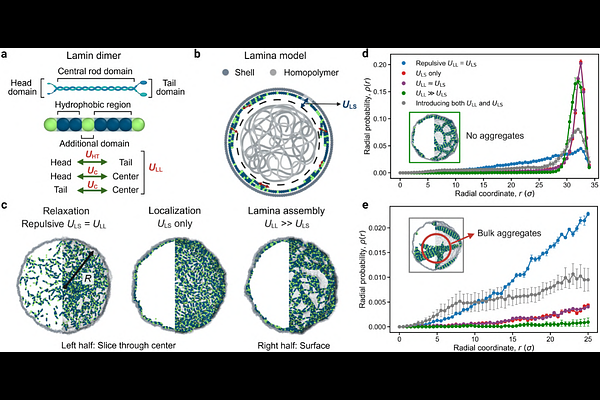
AbstractThe nuclear lamina, composed of supramolecular structures of lamin proteins, is a two-dimensional protein meshwork that preserves the structural integrity, elasticity, and morphology of the nucleus. Lamins--A/C-type and B-type--assemble into dynamic, individual but interacting networks with distinct structural properties. Lamina meshwork assembly can be disrupted by lamin mutations in diseases known as laminopathies. Despite extensive experimental insights, the biophysical mechanisms that alter the lamina meshwork topology in health and disease remain relatively poorly understood. In this study, we develop a coarse-grained molecular dynamics (MD) model of lamina self-assembly, where lamin dimers are modeled as semiflexible polymers confined within an elastic nuclear shell. By systematically interrogating inter-lamin and lamin-shell association affinities, our simulations reproduce a plethora of experimentally observed lamina architectures, from lattice-like to fibrous meshwork topologies. This elucidates how the interplay between inter-lamin and lamin-nuclear envelope interactions can shape the nuclear lamina. Importantly, inter-lamin interactions can cause a heterogeneous distribution of lamins on the surface and result in large, lamin-free surface domains at sufficiently low lamin-shell affinities. Furthermore, paracrystalline lamin sheets form with increasing propensity for parallel lamin alignment, in addition to the canonical, sticky terminal groups. Overall, our integrative MD and network analysis provide the first explicit polymer physics model of the lamina and demonstrate how lamin interactions may affect the mesoscale architecture of the lamina in disease.