Task-specific neural mechanisms underlie biases in human orientation perception

Task-specific neural mechanisms underlie biases in human orientation perception
Leadbeater, R.; Ledgeway, T.; McGraw, P.
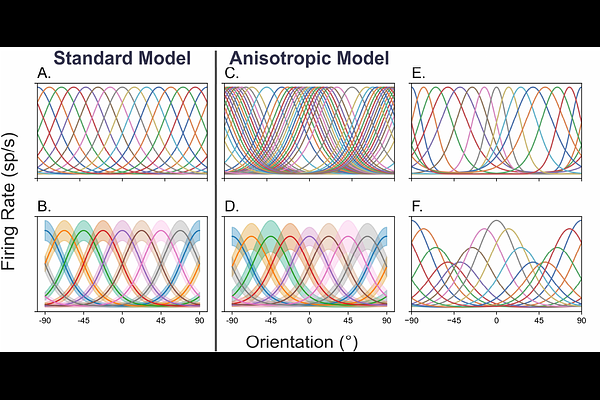
AbstractPrior experience shapes both visual perception and its underlying neural circuits. This is exemplified by the oblique effect - a strong perceptual advantage for cardinal (horizontal/vertical) over oblique orientations - which reflects how the brain adapts to statistical regularities in the natural environment. It remains unclear whether such adaptations are generalised across visual cortex or are specific to circuits supporting different perceptual judgements. To investigate, we examined human performance in contrast detection and orientation discrimination, using identical stimuli for a range of spatial frequencies, paired with a biologically-inspired model of visual orientation processing. Behaviourally, a robust oblique effect emerged for orientation discrimination but was found only at higher frequencies for contrast detection. The model explained detection changes via an increased pooled response from cardinal-tuned neurons alongside spatial frequency-dependent narrowing of orientation bandwidths, consistent with known properties of cortical V1 neurons. However, the discrimination oblique effect required a different constraint, narrower orientation tuning for cardinal versus oblique neurons. No single model captured both effects simultaneously, suggesting that the oblique effect results from task-specific mechanisms. More broadly, these findings demonstrate how, rather than relying on a fixed strategy, the brain employs flexible computational strategies to optimise sensory encoding for specific tasks.