Mutation-agnostic gene insertion therapy for RHO-associated autosomal dominant retinitis pigmentosa using zinc finger nucleases

Mutation-agnostic gene insertion therapy for RHO-associated autosomal dominant retinitis pigmentosa using zinc finger nucleases
Onishi, A.; Sakuma, T.; Mandai, M.; Watanabe, T.; Endo, T.; Nomura, W.; Ishimaru, A.; Inoue, K.-i.; Sho, J.; Ohigashi, Y.; Nakano, Y.; Yasuda, K.; Ozaki, A.; Maeda, A.; Morinaga, C.; Itoh, T.; Inomata, Y.; Momozawa, Y.; Yamamoto, T.; Kiyonari, H.; Hori, S.; Takahashi, M.
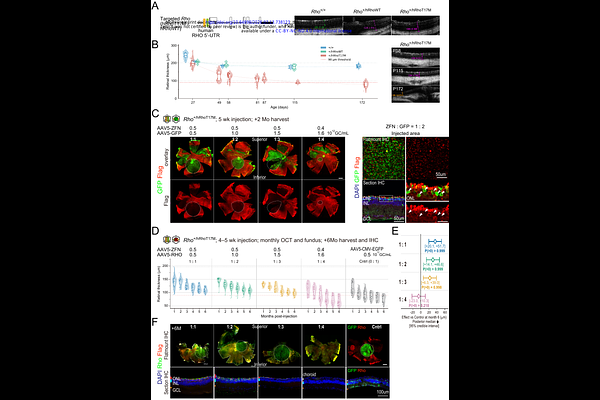
AbstractPurpose: Autosomal dominant retinitis pigmentosa caused by mutations in the rhodopsin gene (RHO-adRP) is among the most prevalent inherited retinal dystrophies. With nearly 100 distinct pathogenic variants identified to date, the mutational heterogeneity of RHO-adRP severely limits the clinical utility of mutation-specific therapeutic strategies. We aimed to develop a mutation-agnostic gene insertion therapy using homology-independent targeted integration (HITI) mediated by zinc finger nuclease ZF-ND1 targeting the human RHO 5'-UTR, and to validate its preclinical efficacy, safety, proof-of-concept, and proof-of-mechanism. Methods: We developed two AAV serotype 5 (AAV5) vectors: one encoding the ZF-ND1 pair (AAV5-ZFN) and one carrying the therapeutic donor cassette (AAV5-RHO), delivered by subretinal co-injection. ZF pairs targeting the RHO 5'-UTR were arranged and refined by in vitro validation; AAV vector optimization and mechanistic verification were performed in human induced pluripotent stem cell (hiPSC)-derived retinal organoids-derived retinal organoids; longitudinal proof-of-concept efficacy and safety were assessed in a humanized RHO-T17M rat disease model by 6-month optical coherence tomography (OCT); and proof-of-mechanism was evaluated in non-human primate retina. Results: We identified a ZF-ND1 pair achieving cleavage efficiency comparable to the SpCas9 RNP previously validated for HITI-mediated editing in mouse retina, and optimized the ZF array composition and NLS configuration for efficient editing especially in post-mitotic photoreceptors. HITI-mediated donor integration was confirmed across multiple cell types and ZFN:donor ratios. In the humanized rat disease model, the therapeutic vector provided outer nuclear layer (ONL) preservation by 6 months, with AAV5-ZFN:AAV5-RHO ratios of 1:1 and 1:2 maintaining ONL thickness above the preservation threshold. In the non-human primate retina, the fraction of HITI-edited rod photoreceptors exceeded the 20% therapeutic correction threshold in the successfully treated individual. Conclusions: These findings support the advancement of this therapeutic vector to first-in-human trials as a mutation-agnostic insertion therapy applicable to all patients with RHO-adRP, irrespective of the specific causative variant.