Onset of Ergodicity Across Scales on a Digital Quantum Processor

Onset of Ergodicity Across Scales on a Digital Quantum Processor
Faisal Alam, Marcos Crichigno, Elizabeth Crosson, Steven T. Flammia, Filippo Maria Gambetta, Max Hunter Gordon, Michael Kreshchuk, Ashley Montanaro, Alberto Nocera, Raul A. Santos
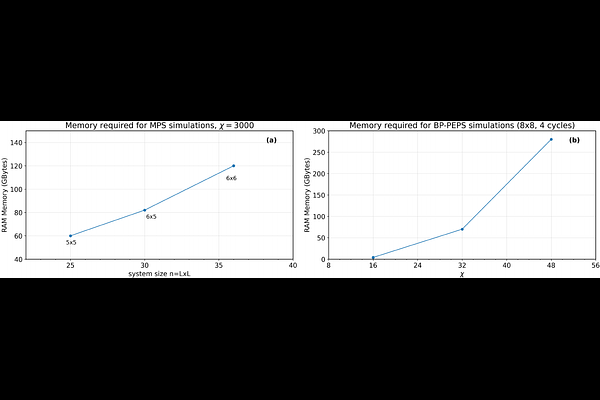
AbstractUnderstanding how isolated quantum many-body systems thermalize remains a central question in modern physics. We study the onset of ergodicity in a two-dimensional disordered Heisenberg Floquet model using digital quantum simulation on IBM's Nighthawk superconducting processor, reaching system sizes of up to $10\times10$ qubits. We probe ergodicity across different length scales by coarse-graining the system into spatial patches of varying sizes and introducing a measure based on the collision entropy of each patch, enabling a detailed study of when ergodic behavior emerges across scales. The high sampling rate of superconducting quantum processing units, together with an optimal sample estimator, allow us to access patches of sizes up to $3\times3$. We observe that as the Heisenberg coupling $J$ increases, the noiseless system undergoes a smooth crossover from subergodic to ergodic behavior, with smaller patches approaching their random-matrix-theory values first, thereby revealing a hierarchy across scales. In the region of parameter space where classical tensor-network simulations are reliable, small patches or small values of $J$, we find excellent agreement with the error-mitigated quantum simulation. Beyond this regime, volume-law entanglement and contraction complexity growth causes the cost of classical methods to rise sharply. Our results open new directions for the use of quantum computers in the study of quantum thermalization.