Reaching vigor tracks learned prediction error

Reaching vigor tracks learned prediction error
Korbisch, C. C.; Ahmed, A. A.
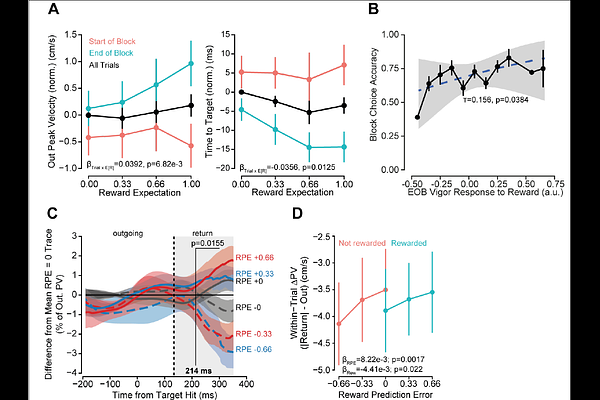
AbstractMovement vigor across multiple modalities increases with reward, suggesting that the neural circuits that represent value influence the control of movement. Dopaminergic neuron (DAN) activity in the basal ganglia has been suggested as the potential mediator of this response. If DAN activity is the bridge between value and vigor, then vigor should track canonical mediators of this activity, namely reward expectation and reward prediction error. Here we ask if a similar time-locked response is present in vigor of reaching movements. We explore this link by leveraging the known phasic dopaminergic response to stochastic rewards, where activity is modulated by both reward expectation at cue and the prediction error at feedback. We used probabilistic rewards to create a reaching task rich in reward expectation, reward prediction error, and learning. In one experiment, target reward probabilities were explicitly stated, and in the other, were left unknown and to be learned by the participants. We included two stochastic rewards (probabilities 33% and 66%) and two deterministic ones (probabilities 100% and 0%). Outgoing peak velocity in both experiments increased with increasing reward expectation. Furthermore, we observed a short-latency response in the vigor of the ongoing movement, that tracked reward prediction error: either invigorating or enervating velocity consistent with the sign and magnitude of the error. Reaching kinematics also revealed the value-update process in a trial-to-trial fashion, similar to the effect of prediction error signals typical in dopamine-mediated striatal phasic activity. Lastly, reach vigor increased with reward history over trials, mirroring the motivational effects often linked to fluctuating dopamine levels. Taken together, our results demonstrate and exquisite link between known short-latency reward signals and the invigoration of both discrete and ongoing movements.