Differential photoperiodic control of morning and evening expressed transcripts in tomato

Differential photoperiodic control of morning and evening expressed transcripts in tomato
Gonzalez-Delgado, A.; Wabnik, K.; Jimenez-Gomez, J. M.
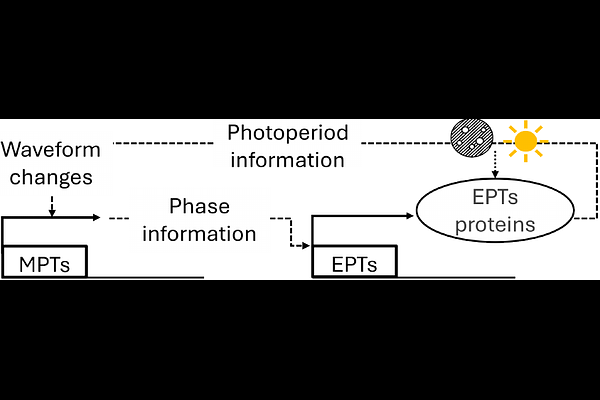
AbstractPhotoperiod, the daily duration of light, is a key environmental cue that varies with season and latitude. Photoperiod signals profoundly influence plant growth and development, and play a central role in crop adaptation across latitudes. Deciphering how plants perceive these seasonal light cues at the molecular level is essential for understanding crop evolution and shaping their geographical distribution. In this study, we investigated how photoperiod influences gene expression dynamics in tomato (Solanum lycopersicum) by performing an RNA-seq time-course across three photoperiod regimes, sampling at two-hour intervals. We use isogenic lines segregating for wild alleles of genes involved in circadian rhythm domestication in tomato to describe their contributions to the circadian clock and flowering time pathways. The high temporal resolution of our experiment allowed precise characterization of transcriptional dynamics and their responses to photoperiod, including shifts in phase, amplitude, and waveform. We found that most transcripts time their expression to dawn or approximately 12 hours later, resulting in a systematic misalignment between evening transcripts and the actual timing of dusk. Morning- and evening-phased transcripts differ markedly in expression levels and waveform responses to changes in photoperiod. Together, these patterns suggest that morning transcripts sense photoperiod transcriptionally, and serve as zeitgeber references for evening transcripts, that could measure photoperiod length by coincidence with external cues. Together, our results provide new insight into the molecular basis of photoperiodic adaptation in plants.