Population geometry reveals directed coupling and transient bistability in spontaneous pituitary secretion

Population geometry reveals directed coupling and transient bistability in spontaneous pituitary secretion
Aquiles, A.; Aparicio Arias, J.; Lafont, C.; Hodson, D.; Santiago-Andres, Y.; Mollard, P.; Fiordelisio, T.
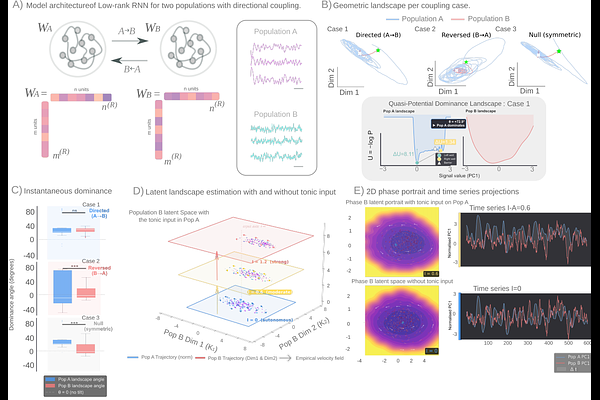
AbstractThe pituitary gland operates as an organized signaling network in which endocrine cell populations coordinate hormone secretion, through homotypic and heterotypic interactions, yet the contribution of spontaneous intrinsic activity in shaping population-level dynamics remains poorly understood. Using geometric analysis of population trajectories, including subspace alignment, manifold separation, and directed coupling metrics , we identifed two classes of spontaneous oscillatory signals associ-ated with distinct cell populations exhibiting asymmetric geometric dominance and a reproducible temporal lag. Our results support that spontaneous activity generates a self-sustained oscillator exhibiting transient bistability, linked to increased physiological demand, with slow oscillations reflecting the properties of an excitatory resonator capable of self-oscillating dynamics without external drive. A low-rank recurrent neural network model recapitulated the empirical geometric landscape under three coupling conditions, confirming that directed population coupling underlies the observed coordination. These findings suggest that intrinsic population dynamics play a central role in coordinating pituitary secretion, with implications for understanding hormonal dysregulation in secretory adenomas and other pituitary disorders.