Hierarchical Logical Processor on the Rotated Surface Code with Shuttle Buses

Hierarchical Logical Processor on the Rotated Surface Code with Shuttle Buses
Zi-Han Chen, Ming-Cheng Chen, Chao-Yang Lu, Jian-Wei Pan
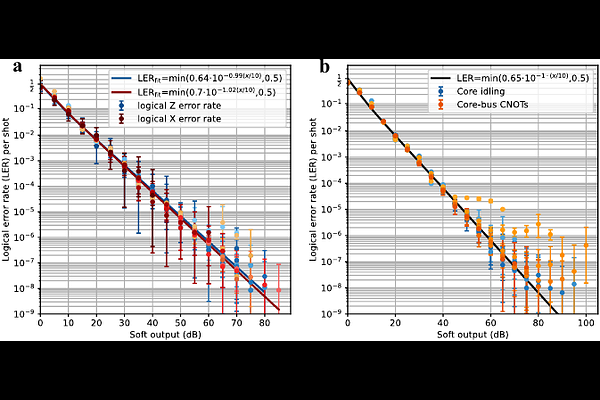
AbstractQuantum platforms with beyond-planar connectivity provide new opportunities for fault-tolerant quantum computation (FTQC). While quantum low-density parity-check (qLDPC) codes offer high encoding efficiency, their direct implementation requires non-local couplings in every round of syndrome extraction, incurring additional physical error and implementation complexity. To reduce the frequency of such couplings, we propose the Hierarchical Logical Processor (HLP), which concatenates a high-rate quantum CSS code with the rotated surface code (RSC). HLPs can achieve beyond-RSC encoding efficiency while requiring long-range connectivity only once every $Θ(d_0)$ rounds of level-0 error correction, where $d_0$ denotes the base-code distance, substantially reducing the frequency of non-local couplings relative to direct implementations of qLDPC codes. HLPs introduce elongated RSC patches called shuttle buses. Using transversal hybrid-unit CNOT gates, a single shuttle bus can simultaneously couple to multiple standard RSC patches. This capability enables efficient level-1 syndrome extraction with suppressed level-1 error correlations and supports highly parallel logical Pauli measurements. We perform circuit-level simulations of several concrete HLP constructions and benchmark both logical memory and logical Pauli measurement performance. At a physical error rate of $10^{-3}$, an HLP based on the [[256,194,4]] code achieves 3-4 times higher qubit efficiency than the standard RSC. Compared with the yoked surface code on the same level-1 code, this HLP reduces the space overhead per logical qubit by 100-200 physical qubits and shortens the logical error-correction cycle time by a factor of 20-30.