Convergent Multimodal Evidence of Cortical Excitation-Inhibition Imbalance in Psychosis

Convergent Multimodal Evidence of Cortical Excitation-Inhibition Imbalance in Psychosis
Varvari, I.; Doody, M.; Li, Z.; Oliver, D.; McGuire, P.; Nour, M. M.; McCutcheon, R. A.
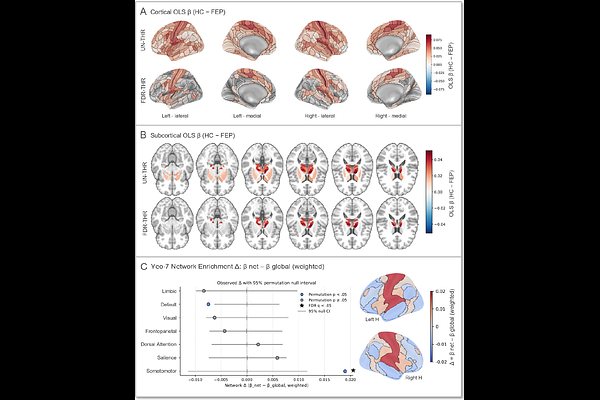
AbstractPsychosis is increasingly understood as a disorder of disrupted cortical excitation-inhibition balance, yet robust non-invasive translational biomarkers remain lacking. The resting-state fMRI Hurst exponent (HE) and EEG aperiodic spectral exponent are promising complementary biomarkers, with lower values in each proposed to reflect a shift towards cortical hyperexcitability, but they have not been jointly examined in psychosis, and the spatial and molecular architecture of HE alterations remains poorly defined. We therefore tested for convergent systems-level signatures across independent cohorts and modalities, using resting-state fMRI (107 patients, 53 controls) and EEG (547 patients, 363 controls). Whole-brain and regional HE were estimated using wavelet methods, and EEG aperiodic exponents were quantified using spectral parameterisation. Compared with healthy controls, individuals with psychosis showed reduced whole-brain HE and widespread regional reductions. Regional HE case-control differences were associated with cortical gene-expression patterns, with enrichment for potassium channel and GABA receptor pathways, and correlated with noradrenergic, muscarinic, serotonergic, glutamatergic and dopaminergic receptor density maps, but not with cortical thickness or symptom or cognitive measures. In the independent EEG cohort, psychosis was similarly associated with a reduced aperiodic spectral exponent. Together, these findings provide cross-modal evidence for altered cortical resting-state dynamics in psychosis, consistent with a shift towards cortical hyperexcitability. Integration with receptor-density and transcriptomic maps implicates biologically plausible molecular pathways and supports HE and EEG aperiodic activity as scalable translational biomarkers in psychosis.