Hierarchical Parameter Estimation for Intrinsic Parameters of Extreme-mass-ratio Inspirals Using Deep Learning

Hierarchical Parameter Estimation for Intrinsic Parameters of Extreme-mass-ratio Inspirals Using Deep Learning
Ping Shen, Wen-Biao Han, Minghui Du
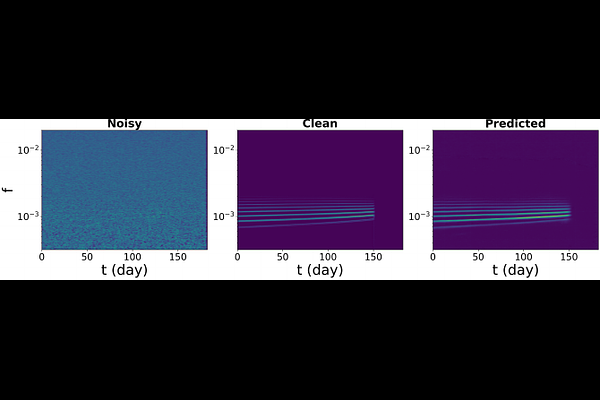
AbstractExtreme-mass-ratio inspirals (EMRIs) stand as prime targets for future space-borne gravitational wave (GW) detectors, yet their precise parameter estimation is severely hindered by waveform complexity and high-dimensional parameter spaces. In this work, we propose a deep learning framework capable of recovering the seven intrinsic EMRI parameters without relying on detailed priors for extrinsic parameters. Our approach first employs a U-Net to extract robust signal features from noisy time-frequency data. These features are then fed into a multi-channel convolutional neural network (CNN) equipped with a dual attention mechanism, which decouples the time and frequency dimensions to jointly model long-range temporal evolution and persistent spectral structures, thereby enhancing sensitivity to EMRI time-frequency ridges in noisy data. Remarkably, this method reduces the search ranges for the parameters $\{\log M, a, μ, e_0, p_0 \}$ and $\{t_p, {x_I}_0 \}$ by factors of $\sim 10^{2}$ and $\sim 10^{1}$, respectively, effectively shrinking the total volume of the seven-dimensional parameter space by $\sim 10^{8}$. Such a dramatic reduction enables a rapid pre-screening of the intrinsic parameter space, substantially saving computational cost for subsequent full parameter estimation. Although our framework is developed with Taiji mission specifications in mind, the methodology is applicable to data from other space-borne GW detectors.