Characterization of Numerical Dissipation in Simulations of Magnetohydrodynamic Turbulence

Characterization of Numerical Dissipation in Simulations of Magnetohydrodynamic Turbulence
Yuyang Hua, Zhonghai Zhao, Bin Qiao
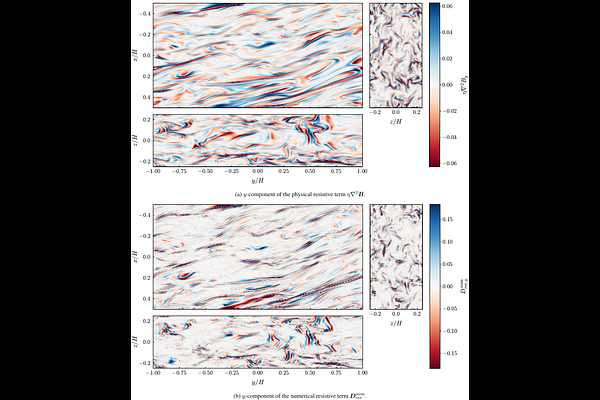
AbstractComprehensive characterization of numerical dissipation is essential for high-fidelity simulations of magnetohydrodynamic (MHD) turbulence. In this work, we present an a posteriori framework for directly estimating numerical dissipation in MHD turbulence from simulation data without invoking a priori assumptions. Implemented in the open-source Python package PyMHD, the framework is applied to simulations of Alfvénic turbulence, turbulent small-scale dynamos, and MRI-driven turbulence, yielding a systematic characterization of the anisotropy and spectral properties of numerical dissipation across these regimes. The results indicate that numerical dissipation primarily dissipates energy transferred by the turbulent cascade at small scales, consistent with the conventional interpretation. However, its spectral properties are distinct from those of physical viscosity and resistivity, such that it cannot simply be represented by effective dissipation coefficients. In addition, numerical dissipation inherits the anisotropy of the underlying turbulence, and can even exhibit anomalous anti-dissipative behavior under certain circumstances. Moreover, this framework enables identification of the conditions under which physical dissipation dominates numerical dissipation across all scales, thereby providing practical guidance for achieving high-fidelity simulations of astrophysical MHD turbulence.