3D Imaging of Honeybee Swarm Assembly and Disassembly

3D Imaging of Honeybee Swarm Assembly and Disassembly
Chase, D. L.; Zhu, D.; Kathait, M.; Robertson, H.; Shah, J.; Harrer, S.; Nave, G.; Bonnie, N. R.; Peleg, O.
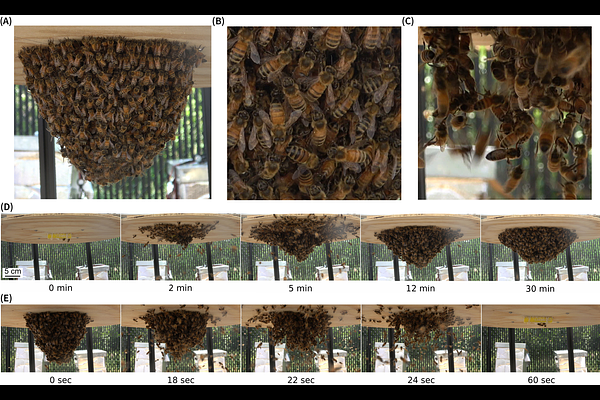
AbstractWhen honeybee colonies reproduce by fission, several thousand bees and their queen depart the parental nest and temporarily form a dense cluster on a tree branch or other surface while searching for a new nest site. Once the new nest site is selected, the swarm disassembles and flies toward it. How honeybees transition rapidly between dispersed flight and an aggregated cluster remains an open question. Here, we develop an experimental system and three-dimensional imaging pipeline to track individual flying bees together with the evolving morphology of the swarm during formation and dissolution. We report results from a representative swarming event. During assembly, swarms rapidly form low-density clusters before undergoing a slower contraction to a more dense steady state configuration. In contrast, disassembly occurs significantly faster than assembly and is characterized by strongly divergent flight, with bees departing the swarm in all directions. Overall, this method is able to demonstrate the coupled flight and morphological dynamics that underlie honeybee swarm assembly. Because the system is relatively low-cost and low-power, it is readily adaptable for three-dimensional imaging of other biological collectives in naturalistic environments.