A long-read human pangenome initiative for comprehensive interpretation of nuclear-embedded mitochondrial DNA

A long-read human pangenome initiative for comprehensive interpretation of nuclear-embedded mitochondrial DNA
Fu, L.; Chen, J.; Lian, D.; Du, S.; Wu, D.; Yang, C.; Wang, Z.; Ma, H.; Li, Z.; Lake, N. J.; APG Consortium, ; Yang, X.; Shi, Y.; Zhang, G.; Ma, K.; Mao, Y.
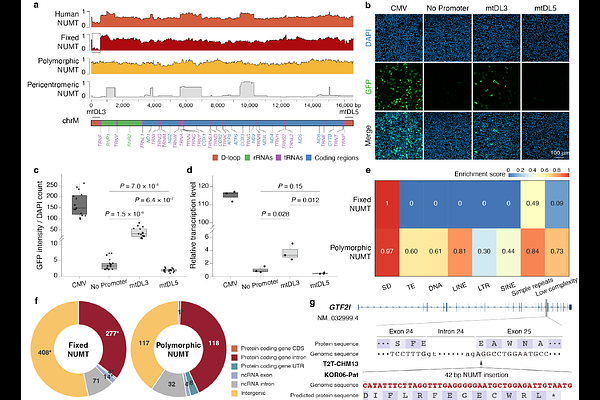
AbstractNuclear-embedded mitochondrial DNA segments (NUMT) preserve a record of ongoing mitochondrial-to-nuclear DNA transfer during evolution, with important implications for disease mechanisms and genome organization. Here, we developed a Pangenome Graph-based NUMT Detection (PG-NUMT) approach to improve NUMT detection sensitivity by 2.52-fold compared to short-read based approaches and comprehensively resolved seven concatenated mega-NUMTs with a maximum length of 127.7 kbp. We generated a high-resolution human NUMT map comprising 774 fixed, 280 polymorphic, and 123 pericentromeric NUMTs, alongside 74 superpopulation-stratified NUMTs. Both fixed and polymorphic NUMTs are hypermethylated and enriched within segmental duplications, whereas fixed NUMTs preferentially localize to intergenic regions and avoid transposable elements. Interestingly, NUMTs derived from the 3'-end of the mtDNA D-loop are less frequently fixed in human genomes and exhibit potential cis-regulatory activity in the nuclear genome. These observations suggest that selective pressures shape the genomic features of fixed NUMTs. Seven NUMTs associated with gene expression or alternative splicing were further identified, suggesting potential modulatory functions of common NUMTs. Using 20 complete non-human primate genomes, we identified variable NUMT insertion rates across primate lineages (1.5-18.7 insertions per million years), with particularly high rates in the Pan lineage. Notably, we uncovered two NUMT-derived variable number tandem repeats (VNTRs), establishing NUMTs as a novel source of VNTRs. In summary, the integrated analysis enhances our understanding of NUMT genomic architecture, population dynamics, and evolutionary implications in human and non-human primates, establishing NUMTs as dynamic genomic components of biomedical relevance.