Rat mediodorsal thalamic subdivisions differentially modulate the sensory and affective components of pain through distinct prefrontal pathways.

Rat mediodorsal thalamic subdivisions differentially modulate the sensory and affective components of pain through distinct prefrontal pathways.
Iben-Daoudi, H.; Ba-Mhamed, S.; Moubarrad, F.-Z. L.; Bennis, M.; LANDRY, M.; Ouhaz, Z.
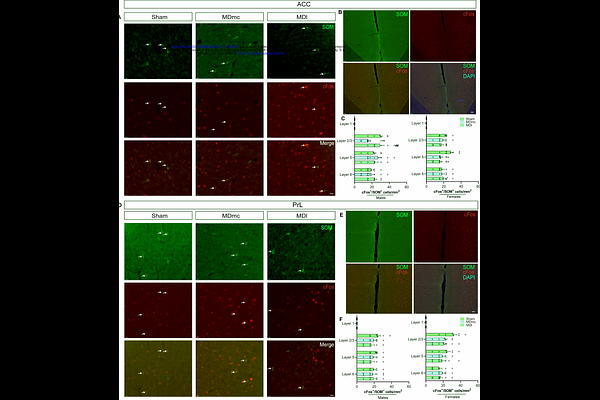
AbstractThe mediodorsal thalamus (MD) modulates pain through thalamocortical regulation of the mPFC. Yet, MD is often treated as a single anatomical and functional entity despite marked internal heterogeneity. Here, we tested whether medial-central MD (MDmc) and lateral MD (MDl) subdivisions exert dissociable control over sensory-discriminative and affective-motivational components of pain by engaging the anterior cingulate cortex (ACC) and prelimbic cortex (PrL). Using subdivision-selective excitotoxic lesions in rats, combined with anterograde tracing, laminar activity mapping, and projection-specific optogenetic manipulation of MDmc and MDl terminals in ACC or PrL, we determined the contribution of each subdivision and the underlying MD-PFC circuit mechanisms. Behaviorally, MDmc and MDl lesions induced mechanical and thermal hypersensitivity, but only MDmc lesions increased pain-related avoidance. Anatomical analyses showed that MDl preferentially innervated ACC PV cells, whereas MDmc more strongly targeted ACC SOM cells. Lesions further produced subdivision-dependent reorganization of nociception-evoked cFos activity in layers 2/3 and 5 and altered PV/SOM interneuron recruitment. Optogenetic manipulations revealed pathway-specific effects: MDmc-ACC/PrL manipulations enhanced nociceptive gain and avoidance, whereas MDl-ACC inhibition increased hypersensitivity while reducing avoidance, and MDl-PrL inhibition increased both nociceptive sensitivity and avoidance. Together, these findings identify MD subdivision-specific thalamocortical pathways that recruit distinct inhibitory microcircuits within ACC and PrL, thereby differentially shaping sensory-discriminative and affective-motivational components of pain.