Diverse lung challenges elicit a conserved monocyte-to-macrophage differentiation blueprint

Diverse lung challenges elicit a conserved monocyte-to-macrophage differentiation blueprint
Iliakis, C.; T'Jonck, W.; Mouat, I. C.; Bankole, S.; Liang, J.; Jones, G.-R.; Kulikauskaite, J.; Burgess, M. O.; Janas, P.; Crotta, S.; Priestnall, S.; Suarez-Bonnet, A.; Schwarze, J.; Wack, A.; Bain, C. C.
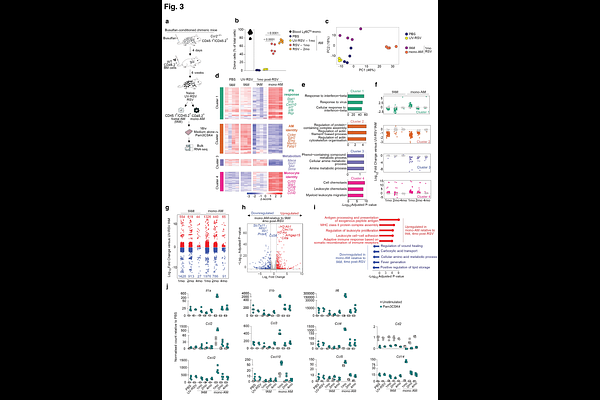
AbstractAlveolar macrophages (AM) form a first line of defence to lung insults. These insults often lead to replacement of foetal-derived tissue-resident AMs (fAMs) by monocyte-derived AMs (mono-AMs) with different functionality, which impacts lung immunity long-term. However, whether these alterations are conserved or insult-specific is not well understood. Here, we show that respiratory syncytial virus (RSV) infection remodels the AM compartment long-term. We perform comparative analyses of fAMs and mono-AMs after RSV infection, influenza (IAV) infection and clodronate liposome administration to derive rules governing the functional and transcriptional changes in AM across insults. We identify a crucial tissue integration checkpoint of CD11b+ mono-AMs which involves acquisition of proliferative capacity and requires EGR2-mediated transcriptional rewiring. Mono-AMs elicited by RSV, influenza or clodronate liposomes have a hard-wired ontogeny-dependent stereotypical profile of transcription, metabolism and enhanced immunoreactivity despite a substantially different inflammatory environment during differentiation; accordingly, mono-AMs, whether elicited by infection or sterile depletion, protect from subsequent S. pneumoniae infection. By contrast, fAMs are more susceptible to subtle, context-dependent transcriptional alterations. Our findings highlight that long-term changes in the AM compartment show origin-dependent phenotypic divergence and that mono-AM integration follows a hard-wired trajectory fine-tuned by environmental factors.