Age determines NK cell fate and tissue compartmentalization to CMV infection

Age determines NK cell fate and tissue compartmentalization to CMV infection
Jensen, I.; Redenti, B.; Wells, S.; Gray, J.; Caron, D.; Farber, D. L.
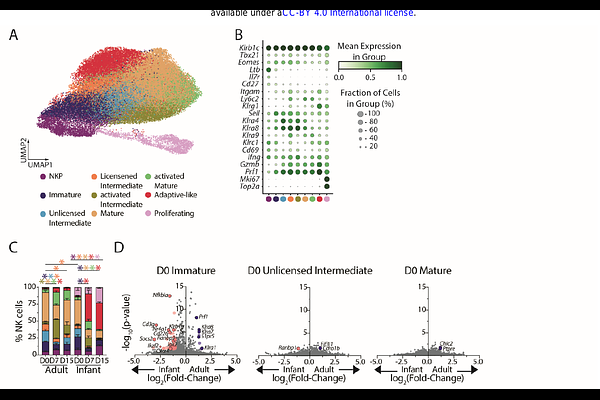
AbstractCytomegalovirus (CMV), a ubiquitous herpesvirus, establishes persistent infection that is controlled by both NK and CD8 T cells. While immunity to CMV is primarily studied in adult mice and humans, most individuals acquire CMV during the early years of life and virus-specific NK and T cell responses during this vulnerable life stage are understudied. Here, we show distinct responses by infant and adult NK cells to CMV infection in both mice and humans resulting from cell-intrinsic features and host T cell responses. Infant mice sustained higher viral loads compared to adults following MCMV infection and exhibited non-redundant requirements for NK cells. Infant MCMV-reactive (Ly49H+) NK cells preferentially expanded adaptive-like subsets which were maintained in tissues and exhibited a distinct transcriptional profile relative to adult NK cells. This biased differentiation of adaptive-like NK cells was altered over age and controlled in part, by competition with memory T cells. We demonstrate similar dynamics with human NK cells; distinct adaptive-profiles for HCMV-reactive NK cells in early life and childhood that change over age and are inversely associated with anti-viral T cell responses. Together, our results reveal that NK cells develop adaptive-like responses and seed tissues in early life to provide protective memory when T cell immunity is limited.