The systemically induced sugar transporter SWEET11 regulates growth-defense trade-offs during Serendipita indica symbiosis in Arabidopsis

The systemically induced sugar transporter SWEET11 regulates growth-defense trade-offs during Serendipita indica symbiosis in Arabidopsis
Jogawat, A.; Menon, S. H.; Sanyasi, M.; Goyal, D.; Nair, A. M.; Vadassery, J.
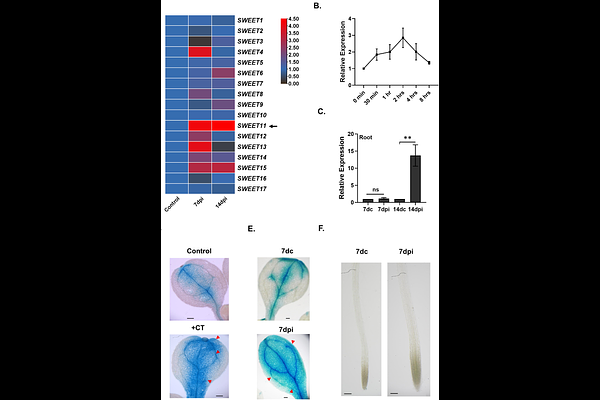
AbstractSugar exchange at the root interface is a pivotal process governing the establishment and stability of plant-fungal symbioses. Precise regulation of sugar exchange determines the success of this ecologically significant interaction. Sugar Will Eventually be Exported proteins (SWEETs) constitute a family of regulatory, energy-independent bidirectional sugar transporters that influence plant development, stress resilience, and survival. However, how specific SWEET transporters coordinate systemic carbon allocation and immune regulation during beneficial plant-fungal interactions remains poorly understood. In this study, we examined the role of the systemically induced Arabidopsis sugar transporter SWEET11 during association with the beneficial endophytic fungus Serendipita indica and following treatment with its elicitor, cellotriose (CT). Expression profiling of SWEET family members revealed a rapid and preferential induction of SWEET11 in aerial tissues upon fungal colonization and CT treatment. Loss-of-function of SWEET11 compromises key mutualistic outcomes, including plant growth enhancement, fungal colonization efficiency, penetration ability, carbohydrate distribution, and the regulation of defense-related phytohormones such as jasmonic acid and abscisic acid. Global transcriptome analysis further demonstrated that SWEET11 regulates whole-plant responses by orchestrating genes involved in central metabolism, secondary metabolite production, sesquiterpenoid and triterpenoid pathways, as well as defense signaling and nutrient transport systems. We show that SWEET11 interacts with a stress associated SNF1-related protein kinase (SnRK2.8) and plays a crucial role in enabling fungal establishment while mitigating host defense responses, and supporting plant growth. Our data shows that SWEET11 functions as a shoot-derived sugar exporter that directs carbon toward roots, facilitating sugar unloading to S. indica. This controlled carbon supply allows the fungus to meet its metabolic demands without disrupting host sugar balance, thereby maintaining a stable and well-regulated symbiotic association under immune constraints.