A lepto-hadronic perspective on the properties of the candidate neutrino-emitter blazar 5BZQ J0808+4950

A lepto-hadronic perspective on the properties of the candidate neutrino-emitter blazar 5BZQ J0808+4950
Margot Boughelilba, Leonard Pfeiffer, Jose Maria Sanchez Zaballa, Alessandra Azzollini, Annette Bremer, Sara Buson, Massimiliano Lincetto
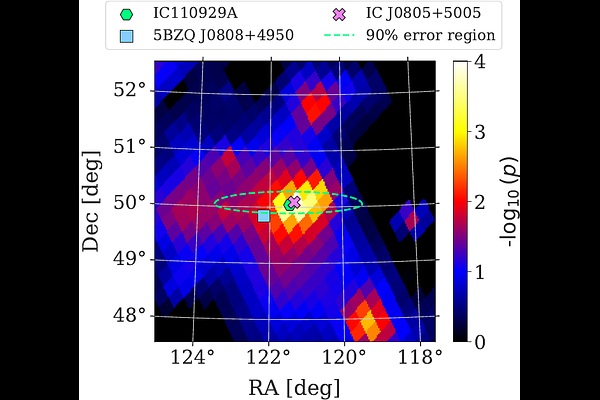
AbstractThe role of active galactic nuclei in the production of high-energy neutrinos has been highlighted by the association of the blazar TXS 0506+056 and the Seyfert galaxy NGC 1068 with IceCube neutrino events. In particular, blazars, with their powerful jets, are potential sites of neutrino production via (photo-)hadronic interactions. The gamma-ray bright blazar 5BZQJ0808+4950 is consistent with a spatial anisotropy in the IceCube neutrino all-sky maps. An individual high-energy neutrino event, IC110929A, was also reported in the direction of this blazar. Although the correlation between the gamma-ray bright blazars and the neutrino production remains inconclusive, 5BZQ J0808+4950, with a luminous accretion disk serving as a photon field for the photo-hadronic interactions, offers the opportunity to test the relation between neutrino production and the radiative output of the blazar jet. We compile available multi-wavelength data and analyze the gamma-ray light curve of 5BZQ J0808+4950, leading us to define six contemporaneous epochs to model the source's spectral energy distribution and its evolution over time. We use a lepto-hadronic, time-dependent framework to model 5BZQ J0808+4950, taking into account external photon fields. We find that the solutions corresponding to the different states the source exhibits are explained mostly by a change in the particles' injection properties. The correlation between the predicted X-ray and the neutrino luminosity in this source is stronger than the correlation between gamma-ray and neutrino luminosity. We predict that the rate of neutrinos detectable by IceCube for this blazar ranges from $\sim 10^{-3}$ to $\sim10^{-1}$ neutrinos per epoch. Assuming Poisson statistics, the predicted neutrino number contemporaneous with the interval in which the high-energy neutrino event IC110929A was detected, is compatible with the detection of one neutrino.