Probing the QPO and spectro-temporal evolution of MAXI J1750-327 with XPoSat during its first detected outburst : Constraints on black-hole mass and spin

Probing the QPO and spectro-temporal evolution of MAXI J1750-327 with XPoSat during its first detected outburst : Constraints on black-hole mass and spin
Meghamani Haldar, Biki Ram, Shubhrangshu Ghosh, Kishor Chaudhury, Rajat K. Dey, Tamal Sarkar
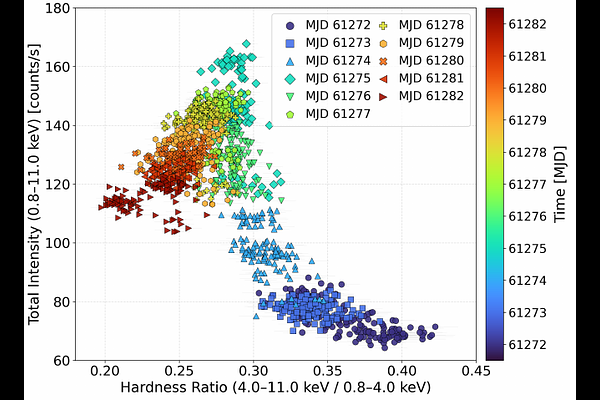
AbstractWe present a comprehensive timing and broadband spectral study of the newly discovered black hole low-mass X-ray binary candidate MAXI J1750-327 during its August 2026 outburst, using 11 continuous observations obtained with the XSPECT instrument onboard XPoSat. During epochs 1-2, we detect prominent type C QPO exhibiting a systematic upward frequency drift, accompanied by a prominent low-frequency noise component, with a clear transition from type-C to type-B, with subsequent disappearance of QPOs after epoch 4. Broadband spectral modeling reveals that this timing transition is directly mirrored by a fundamental restructuring of the accretion geometry. The inner disk temperature abruptly increases before settling into a steady range, accompanied by a steep reduction in disk normalization across the transition from epoch 3 to 4. This behavior signifies an active dynamical inward migration of the thin accretion disk toward the innermost stable circular orbit (ISCO). The Comptonized flux declines sharply after the QPO turns off, suggesting a transition from a hard to soft state, through intermediate states. We also observed that the spectro-temporal correlations provide compelling physical support for the Lense-Thirring (LT) precession framework to be the origin of the type-C QPOs. Using a Bayesian framework, we constrain the black hole mass to be $M_{\rm BH}=7.92^{+6.19}_{-3.72} M_{\odot}$ and the dimensionless spin parameter to be $a_*=0.163^{+0.116}_{-0.056}$ by jointly modeling the observed type-C QPO frequencies with the global LT precession model and marginalizing over the uncertainties in distance, inclination, and diskbb normalization.