From mass-loss histories to lightcurves: a generalised framework for interaction-powered transients

From mass-loss histories to lightcurves: a generalised framework for interaction-powered transients
Nikhil Sarin, Ryosuke Hirai
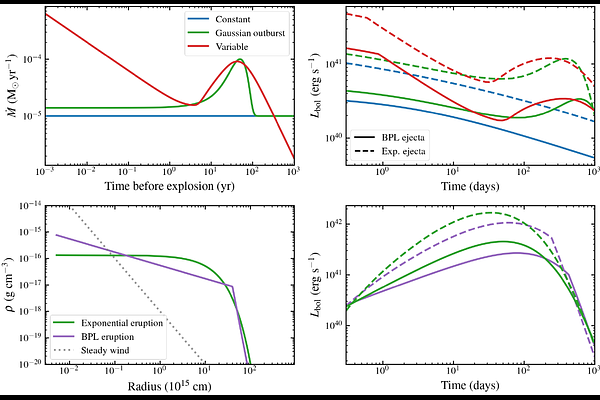
AbstractWe introduce a fast ($\sim 1$-$50$ ms) and generalised framework for modelling interaction-powered transients. The framework solves the thin-shell equations of motion for ejecta colliding with circumstellar material (CSM), and supports arbitrary CSM density and velocity profiles, including steady winds, eruptions, and complex time-variable mass-loss histories. For optical/UV lightcurves, we implement two luminosity treatments: a fast one-zone mode based on the thin-shell shock power, and a finite-shell transport mode that evolves trapped radiation, photon diffusion, shock emergence, and post-emergence cooling for finite, static CSM shells. In a benchmark comparison, the transport calculation and an optional time-dependent shock-efficiency prescription reproduce the main qualitative and quantitative features of a one-dimensional radiation-hydrodynamical simulation. We use the same shock solution to post-process radio synchrotron and thermal bremsstrahlung X-ray predictions, enabling self-consistent multi-wavelength diagnostics. We show that the assumed CSM velocity structure can significantly affect inferred parameters even when the density profile at explosion is identical, and that aspherical CSM can mimic multiple spherical shells in bolometric lightcurves. We demonstrate the framework through recovery of a synthetic time-variable mass-loss history and applications to six transients: the Type IIn SN~2010jl, the rapidly evolving stripped-envelope SN~2023xgo, the Type Ia-CSM SN~2020aeuh, the hydrogen-poor superluminous SN~2015bn, the eruptive LBV-like transient SN~2009ip, and the long-duration interacting event iPTF14hls. The inferred CSM structures span steady or enhanced winds, thermonuclear interaction, eruptive density enhancements, and highly structured pre-supernova mass loss, illustrating the framework's utility for inference on upcoming large samples of interacting transients.