Does the spectral break in the IceCube diffuse neutrino spectrum originate from AGN evolution?

Does the spectral break in the IceCube diffuse neutrino spectrum originate from AGN evolution?
Caijin Xie, Zijian Qiu, Yudong Cui, Sujie Lin, Lili Yang
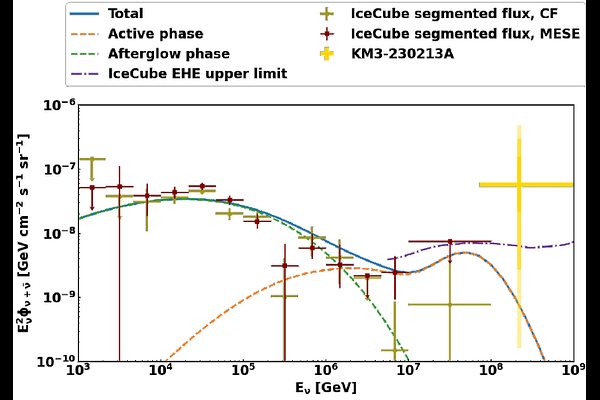
AbstractThe enigmatic origin of the diffuse neutrino background detected by IceCube in the energy range from TeV to PeV remains one of the central open problems in high-energy astrophysics, and this puzzle is further deepened by the recent evidence for a spectral break. Could this convex-spectrum background arise predominantly from the evolution of active galactic nuclei (AGNs)? In this work, we claim that the spectral break is naturally predicted when AGN evolution is taken into account, and the diffuse flux can be interpreted as the superposition of contributions from AGNs at different evolutionary phases. We develop a unified framework that incorporates AGN evolution, where cosmic rays (CRs) accelerated during the active phase subsequently diffuse and interact in the host galaxy after the central engine switches off, producing a long-lived hadronic afterglow. Adopting physically plausible parameters, our model successfully reproduces both the spectral features of the diffuse background and the observed neutrino emission from representative sources such as TXS 0506$+$056 and NGC 1068. Our results suggest that AGN host galaxies are more efficient CR reservoirs than previously expected. Moreover, the model favors a lepton-dominated scenario for most AGNs. This conclusion accounts for the relatively low detection rate of point-like sources by IceCube and underscores the need for next-generation neutrino telescopes with larger effective areas and higher sensitivity.