Delayed Radio Flares in Neutrino-associated Blazars: The Case of TXS 0506+056

Delayed Radio Flares in Neutrino-associated Blazars: The Case of TXS 0506+056
S. I. Stathopoulos, C. Yuan, G. Vasilopoulos, F. Testagrossa, D. Karavola, M. Petropoulou, W. Winter
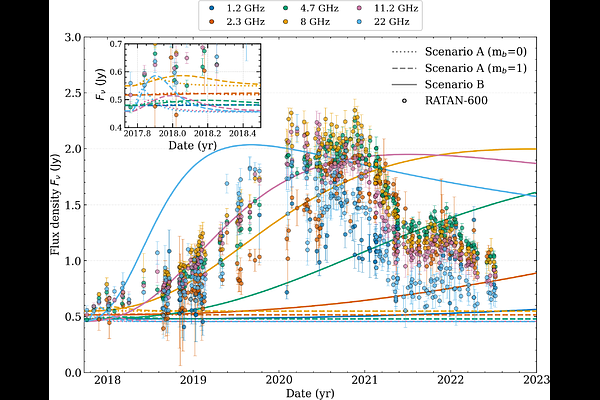
AbstractRadio flares have been postulated to be associated with the production of astrophysical neutrinos. For example, TXS 0506+056 exhibits a 2-3 yr delay between the 2017 IceCube-170922A/$γ$-ray flare and a GHz radio maximum. We quantitatively test if the delayed radio flare originates from the same compact region where neutrinos and $γ$-rays are produced as it expands downstream and synchrotron self-absorption (SSA) is reduced. Starting from the 2017 flare blob parameters, we model the expanding production region and its evolving radio emission with LeHaMoC in a fully time-dependent framework, and compare our 1.2-22 GHz light curves to RATAN-600 data. We study different scenarios with increasing levels of sophistication, including continuous injection and energy re-dissipation on pc scales. While a simple expanding blob scenario fails to reproduce the radio data, a downstream dissipation episode of particles in the optically thin regime, followed by jet deceleration, successfully describes the radio evolution. Within our one-zone time-dependent framework, the delayed radio flare is unlikely to come from an expanding neutrino production zone becoming transparent to radio emission. Additional ingredients are needed, such as re-dissipation downstream with a subsequent Doppler-factor decline. The radio flare is powered by leptonic synchrotron emission and is largely insensitive to the proton population relevant for neutrino production, implying that the delayed radio flare mainly probes downstream dissipation and beaming in certain jet configurations rather than being a genuine feature associated with the neutrino production.